


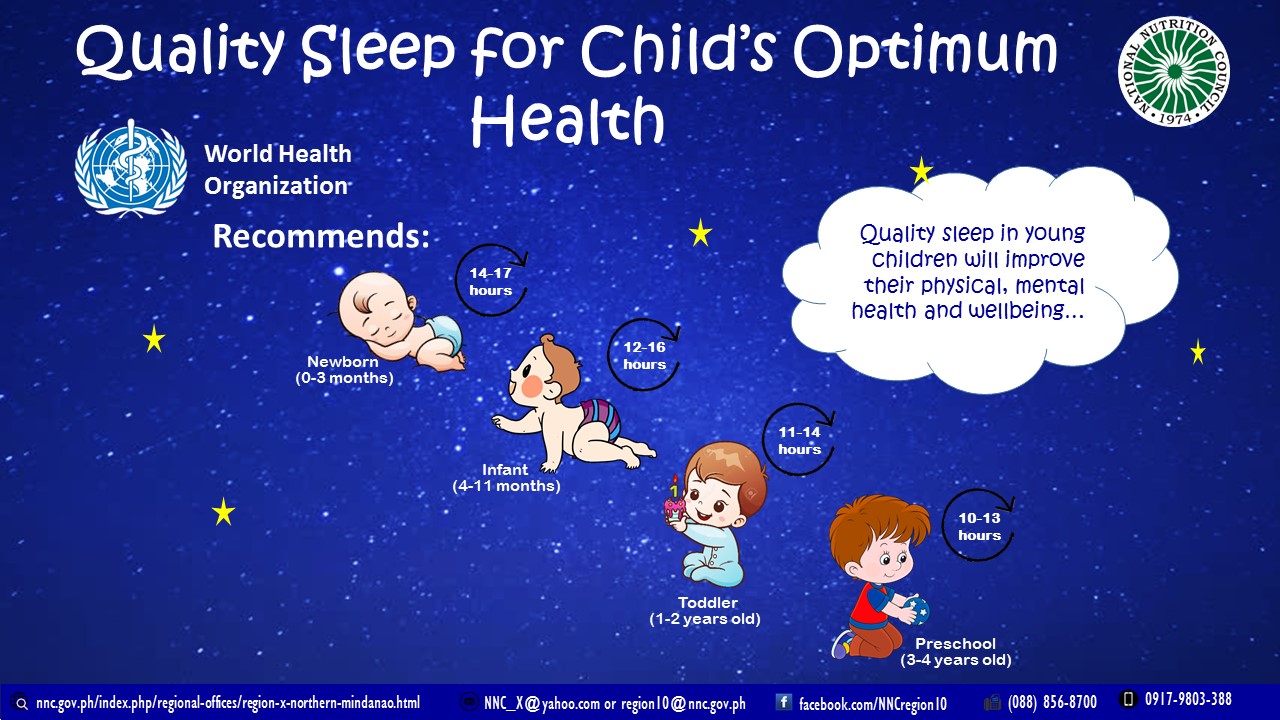
 Sleep is as important to food and water especially to a developing child. It has a direct impact on the physical, emotional, and behavioural health of children. A study conducted by Xie et al. (2013) entitled “Sleep Drives Metabolite Clearance from the Adult Brain” shows that sleep has an integral part in brain functions, in fact, recent findings indicate that sleep plays a role in removing toxins build up in the brain.
The prefrontal cortex is the part of the brain that carries out executive processes such as thinking, decision making, and planning. The brain’s cognitive functions including attention, learning, understanding and memory are all entirely dependent to the functioning of prefrontal cortex. This region of the brain is more active to those who have adequate sleep than to those who under slept. It is also during sleep that the acquired memories, information and skills are transferred and stored to permanent brain regions. Thus, children with adequate sleep are more alert and retains learning or skills over a long period of time.
Researchers recognized the importance of quality sleep, getting enough sleep at the right time. Good sleep is a lifelong habit which would benefit the children in their later years. Sleep is significantly associated with immunity, hormonal and metabolic functions. Recent US studies show that 60% of children do not get enough sleep and if this happens over a long period of time, it may put the child’s optimal health and development at stake.
World Health Organization (2019) recommends the number of sleep hours should including naps per 24-hour period for 0 months to 5 years old children:
| Age | Recommended Sleep Hours per 24 hour Period |
| Infant: 0-3 months | 14–17 hours |
| Infant: 4-11 months | 12-16 hours |
| Toddlers: 1-2 years old | 11-14 hours |
| Preschool Children: 3-5 years old | 10-13 hours |
Short sleep duration is associated with a wide range of negative health outcomes. Lack or inadequate sleep affects the brain’s ability to focus. Sleep insufficiency reduces body production of cytokines, a type of protein that regulates immunity. One study shows that even an hour lack of sleep a day may cause neurobehavioral degradation (Basner et al, 2013). As what Touchette et al. (2007) stated, short sleep duration during the first 3 years of life may have long term consequences.
It is during childhood that sleep and emotion regulatory system develops. Constant inadequate sleep during childhood may elevate the risk for developing depression or anxiety disorder in later years. Alfano, associate psychology professor at the University of Houston, says “Healthy sleep is critical for children’s psychological well-being.” Children who experience inadequate sleep are usually grumpy, short-tempered and increases the likelihood of intense or impulsive emotional responses. They are also less reactive to positive things that may create negative emotions and may also alter positive emotions. These behavioural change may later develop or elevate risk to depression and may deprived quality life.
Children’s exposure to television, internet, mobile and other electronic games is found to be one of the reasons why children get inadequate sleep. It has been found that exposure to the light of electronic devices delay the melatonin release and retard sleep onset. Melatonin is a hormone that helps control the body’s sleep-wake cycle. It is the body’s internal clock wherein production and release of melatonin are associated to the time of day. Melatonin level rises in the evening and drops in the morning, thus signaling the body to sleep and wake up.
Naturally, a child’s sleeping pattern may alter from time to time. To parents and caregivers, it is important to help the child develop a sleep routine, especially at night to allow the child’s mind and body to rest and recover. The above-mentioned recommendation was simply a guideline to help a child have the right amount of sleep or quality sleep. Lastly, according to Dr. Fiona Bull (WHO, 2019) “Quality sleep in young children will improve their physical, mental health and wellbeing, and help prevent childhood obesity and associated diseases later in life”. (NO I Arlie Joy O. Damiles)