


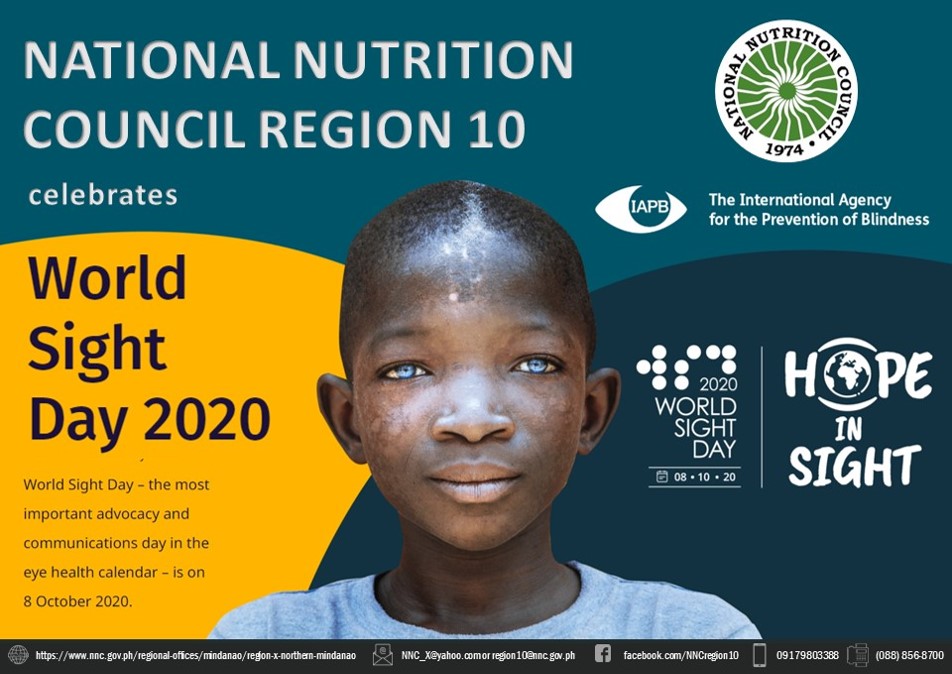
 World Sight Day (WSD) is commemorated annually, every second Thursday of October to seek awareness and pay attention to the problem of visual impairment and blindness across the globe. The event started since 2000. This year, the event was organized by the International Agency for the Prevention of Blindness (IAPB), a premier eye health body that envisions a world with no unreasonable visual impairment where people have access to quality eye health care and where individuals with irreversible vision loss achieve their full potential. WSD serves a way for organizations to seek active support from the governments, corporations, institutions, and individuals to make access to eye health available for all.
This year, the celebration falls on the 8th day of October with the theme, “Hope in Sight”. The theme commemorates the success of passing a resolution for eye health as an integral part of the Universal Health Coverage (UHC) on the recently conducted World Health Assembly. WSD20 Photo Competition highlights this year’s celebration, encouraging both amateur and professional photographers all over the world to join by sending photos emphasizing the impact of eye health in people’s lives.
According to IAPB, more than 2.2 billion individuals globally are suffering from visual impairment with at least 1 billion cases that could have been prevented or resolved. The Philippine National Blindness Survey and Disease Study conducted last 2018 also revealed that 1.11 million Filipinos suffers from cataract, 400,000 has uncorrected error of refraction, almost 300,000 are suffering from glaucoma, and 200,000 are with maculopathy. Furthermore, over four million Filipinos are living with undiagnosed eye problems. Affected population may suffer from lifelong effects in most areas of their lives, which includes their daily personal activities, community interaction, school and work opportunities and their capacity to access public services. The number of individuals suffering from poor eye health is so alarming thus, actions should be done to mitigate this case.
Poor eyesight can be due to factors including diseases and conditions such as diabetes and trachoma, eye trauma, refractive error, cataracts, glaucoma, among others. Individuals who are over 50 years old are most likely to suffer from visual impairment yet vision loss may affect people of all ages.
The goal of this yearly celebration includes raising awareness to the public on the issues related to blindness, and visual impairment and educating them about blindness prevention, persuading the governments to advocate and allocate funds for blindness prevention programs, and gaining support for Vision 2020 programs and activities. Seminars, donation drives rallies and online events are among the activities conducted globally to celebrate WSD.
The National Nutrition Council (NNC) Region 10 is one with the world in celebrating this momentous event. Amid the pandemic, NNC X together with its mother agency, the Department of Health are committed to its advocacy on blindness prevention by constantly providing programs and services to eradicate all forms of malnutrition, particularly those that may cause visual impairment such as Vitamin A Deficiency (VAD). This includes continuous provision of Vitamin A capsules to all children less than five (5) years old, provision of Ready-to-use Therapeutic Foods (RUTF), Ready-to-use Supplementary Foods (RUSF) and Lipid-based Nutrition Support (LNS) to targeted undernourished children and pregnant women, distribution of Micronutrient Powder (MNP) to children 6-23 months old, among others. Nutrition education via online and provision of Information and Education Campaign (IEC) materials are still being done to enhance the knowledge of the public on establishing and maintaining proper nutrition, especially during this time of the pandemic.
Nutrition plays a very important role in ensuring the overall health of an individual, including eye health. Let us make the most out of our precious sense of sight by living in a proper lifestyle, eating with proper nutrition in mind and sleeping at least six hours a day. Above all, it is best to seek eye-related medical advice regularly to ensure proper eye health. In our little ways, let’s ensure that no one is left behind as we show our support to giving hope in sight. (PNC Stephanie C. Barrio)
References:
Awareness Days (2020 October 8). World Sight Day 2020. https://www.awarenessdays.com/awareness-days-calendar/world-sight-day-2020/
De Vera E. and Noriega R. (2019 November 12). DOH to look into visual health as WHO reports growing number of people afflicted by eye problems. Manila Bulletin. https://mb.com.ph/2019/11/12/doh-to-look-into-visual-health-as-who-reports-growing-number-of-people-afflicted-by-eye-problems/
International Agency for the Prevention of Blindness (n.d.). Hope in Sight. https://www.iapb.org/advocate/world-sight-day/
Operation Eyesight (2020 October 2). Bringing Hope in Sight – The Importance of Eye Health on World Sight Day. https://www.globenewswire.com/news-release/2020/10/02/2103023/0/en/Bringing-Hope-in-Sight-The-Importance-of-Eye-Health-on-World-Sight-Day.html
World Health Organization (2020 October 8). World Sight Day 2020. https://www.who.int/news-room/events/detail/2020/10/08/default-calendar/world-sight-day-2020
World Health Organization (2018, October 08). World Sight Day. https://www.who.int/blindness/world_sight_day/en/