


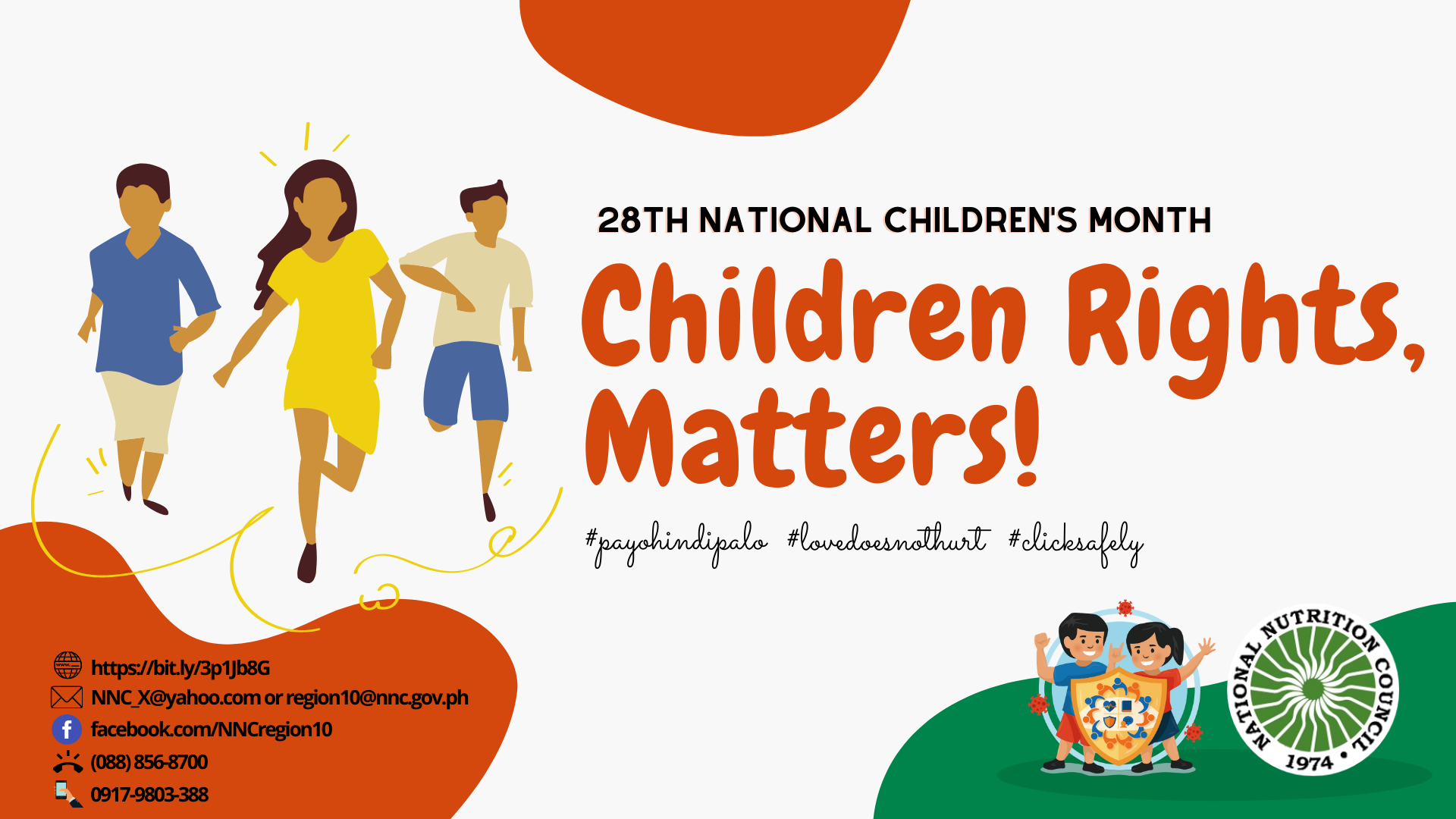
 November marks the celebration of the National Children’s Month (NCM) by virtue of Republic Act 10661, adopting the United Nation Children Rights Commission (CRC) on 20 November 1989. This year marks the 28th anniversary that focuses on upholding children’s rights during the COVID-19 pandemic.
This year’s theme is “Sama-samang Itaguyod ang Karapatan ng Bawat Bata sa Panahon ng Pandemya!” anchored on the UN CRC and the 3rd National Plan of Action for Children (NPAC) goals to progressively realize the rights of children, provide practical support to parents and caregivers on how to care for children and themselves during the pandemic, empower children to protect themselves and report experience of abuse and guide Local Government Units (LGUs) to efficiently deliver their expected roles, and functions.
The celebration is an awareness that children have the rights to be protected and valued. Republic Act 7610 known as “Special Protection of Children Against Abuse, Exploitation, and Discrimination Act” states that to give special protection to children from all concerns of abuse, neglect, cruelty exploitations, and discrimination and other conditions that harm their growth and development and to provide sanctions to the offender of the law and conduct a program for prevention and discourage action in situations of child abuse, exploitation and discrimination. Also, Republic Act 9941 known as “Juvenile Justice and Welfare Act of 2006” recognizes the vital role of children and youth in nation building and shall promote and protect their physical, moral, spiritual, intellectual, and social well-being. It will instill in the youth patriotism and nationalism, and encourage their involvement in public and civic affairs.
However, the 2015 National Baseline Study on Violence Against Children (NBS – VAC) revealed that most Filipino children experience and are vulnerable to physical, psychosocial, and sexual violence in any setting, but it is significantly high in the home. According to the Council for the Welfare of Children (CWC), 3 in 5 children suffer one or two forms of violence at home, while parents and other members of the family (brothers, cousins, and sisters) are often the perpetrators of abuse. Due to the danger posed by the pandemic and the community quarantine still in effect, restriction in the people’s movement exacerbates the problem, thus affecting the children’s the right to strive, grow and develop. In this age, children should play and socialize with other peers, express their feelings, speak up, and ask for help if they need it yet the distress brought about the situation increases the vulnerability of children to violence where they are trapped inside the home they share together with their perpetrators and may not be able to seek immediate protection or help because of they are limited access to people who they trust or seek help.
The 2020 NCM aims to stimulate advocacy and public information on upholding child rights amid COVID-19. It aims to: 1) intensify public awareness and knowledge on children’s rights, adequate care and protection for children, and application of positive discipline in a daily dealings with children; 2) promote further the institutionalization of a child-friendly environment and governance by promoting implementation and monitoring of child – related protocols at the sub – national levels; 3) provide a platform for discourse on persistent and arising issues pertaining to children’s rights to survival, development, protection, and participation during and post COVID-19; 4) empower the children as rights-holders to claim and protect their rights; and 5) equip the duty-bearers to deliver their commitment and fulfill their obligations to protect children and fulfill rights of children.
Among the survival rights of a child is the right to access to basic health and nutrition services. Along this line, families, communities, local nutrition committee members and stakeholders should ensure that children are nurtured, starting from the mother’s womb, up to two years of age, and beyond. This is to protect also the children from the short and long-term negative consequences of malnutrition.
The National Nutrition Council Region X, joins the NCM celebration by promoting, supporting and advocating NCM objectives through hanging of streamer and information dissemination via quad media. An example of NNC X’s efforts on this for social media is through the NCM 101 and Kid’s Nutri-Corner. The NCM 101, to be posted every Wednesday, gives concepts and background of the celebration, while the Kid’s Nutri-Corner will share trivia on children’s nutrition every Friday of the week. Moreover, the organization declared its support to the rights of children through recitation of “Panatang Makabata” (Cebuano Version). Online activities and webinars relative to the NCM are also shared widely to nutrition workers and networks.
Altogether, the LGUs, government agencies, and non-government organizations support the celebration to achieve well-nourished, healthy and active children with good quality education; and safe, and free from violence, abuse, neglect, and exploitation. This is not impossible with the help of the parent’s care and love of their children where promoting positive discipline over violent discipline or what we called it “payo hindi palo” awareness. In addition to that the parents must also be aware of safe internet usage to fight against sexual abuse and cyber bullying. (NO I Vazamija Therese A. Villasi)
Reference:
Council for the Welfare of Children. 2020 National Children’s Month – Background. Retrieved on 6 November 2020 from https://cwc.gov.ph/advocacy/children-s-month/2020/background-2020.html
Republic Act No. 9344. Retrieved on 6 November 2020 from https://www.officialgazette.gov.ph/2006/04/28/republic-act-no-9344-s-2006/
Republic Act No. 7610. Retrieved on 5 November 2020 from https://www.officialgazette.gov.ph/1992/06/17/republic-act-no-7610/
UNICEF. Child rights and why they matter. Retrieved on 6 November 2020 from https://www.unicef.org/child-rights-convention/child-rights-why-they-matter