


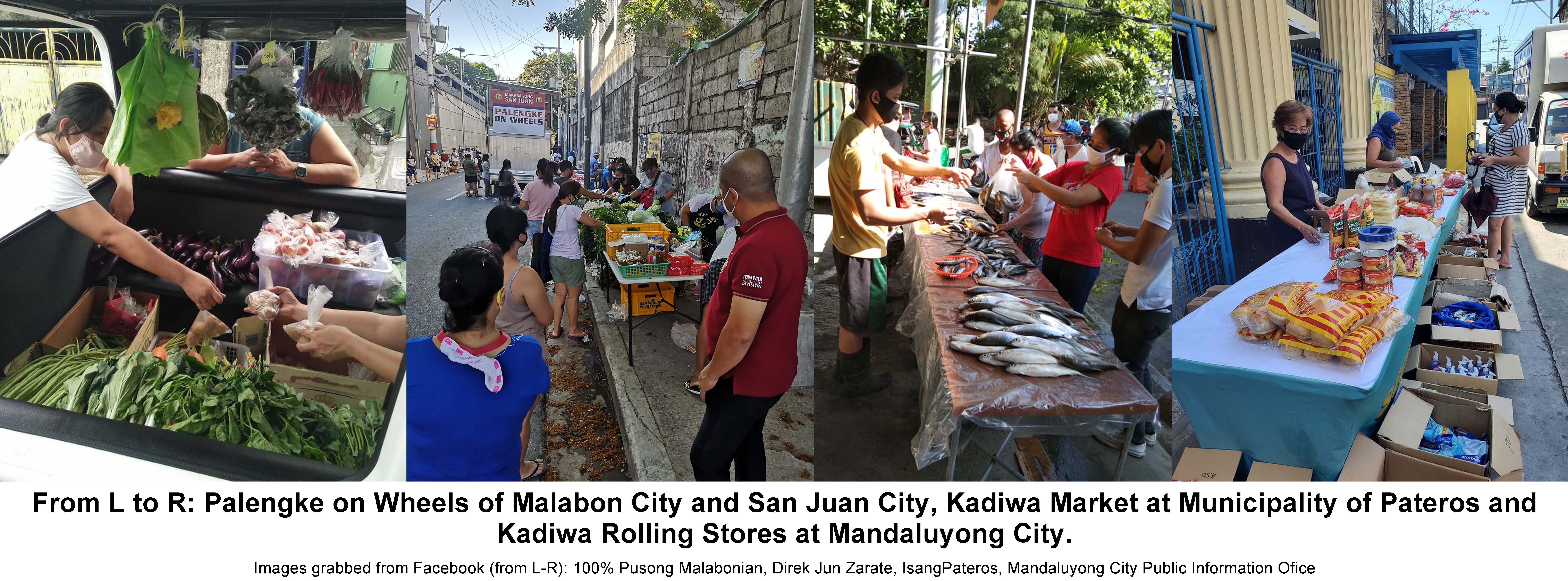
 More local government units in Metro Manila have set up mobile markets or Kadiwa stores to ensure that their constituents have access to basic food commodities. Four (4) Metro Manila LGUs have rolled out their mobile markets this April, namely Malabon, San Juan, Mandaluyong and Pateros. This is in addition to the ten (10) LGUs that launched their mobile markets last March as part of their COVID-19 response during this Enhanced Community Quarantine (ECQ) period. At present, 14 out of the 17 Metro Manila LGUs have their own mobile markets except for the cities of Marikina, Manila and Las Pińas.
The city of Malabon rolled out their Palengke on Wheels on April 1 to bring the market closer to the residents. The city’s electric tricycles or e-trikes carry fresh vegetables, rice, egg, chicken and pork that are sold from 9:00 to 11:30 in the morning and 3:00 to 6:00 in the afternoon at selected barangays.
Mandaluyong City’s Mobile Palengke also started its run on April 1, making it easier for their residents to buy food without going far from their homes. It also prevents public markets from being crowded in compliance to social distancing. The mobile palengke goes around the city from 8:00 to 11:30 in the morning and 2:30 to 5:30 in the afternoon.
Kadiwa rolling stores also operate in Mandaluyong City in addition to the e-trike mobile palengke. The Kadiwa rolling stores, in partnership with Paymaya, sell grocery items such as canned goods and condiments as well as other basic commodities such as hand and bath soaps and liquid detergents, among others.
San Juan City launched its Palengke on Wheels on April 4 in partnership with the market stall owners in Agora Market. The city’s Palengke on Wheels visits barangays from 6AM to 9AM and from 10AM to 1PM.
Pateros Mayor Miguel “Ike” Ponce partnered with Kadiwa to set up a temporary market or talipapa in front of the municipal hall. Instead of going to the market in neighboring cities, residents can now buy fresh produce and other food items in the temporary market or talipapa. Operating daily since March 28, the temporary market sells fish, poultry, eggs, fresh vegetables, rice and canned goods.
Putting up mobile markets is a timely and laudable initiative of these LGUs, helping people have better access to fresh and affordable food products, while helping farmers and fisherfolk earn at the same time. Residents patronizing these mobile markets are also required to wear facemask and observe social distancing to prevent the spread of COVID-19.
“Household food security is a priority,” says Agriculture Secretary William Dar. The Department of Agriculture together with the local government units are hopeful that with these initiatives, the people will have better access to nutritious and affordable foods. “No one should be left behind in our war against hunger especially during this Covid-19 pandemic,” concluded Secretary Dar. (DA Communications Group/TAR/NPC MEVF/NNC-NCR)