


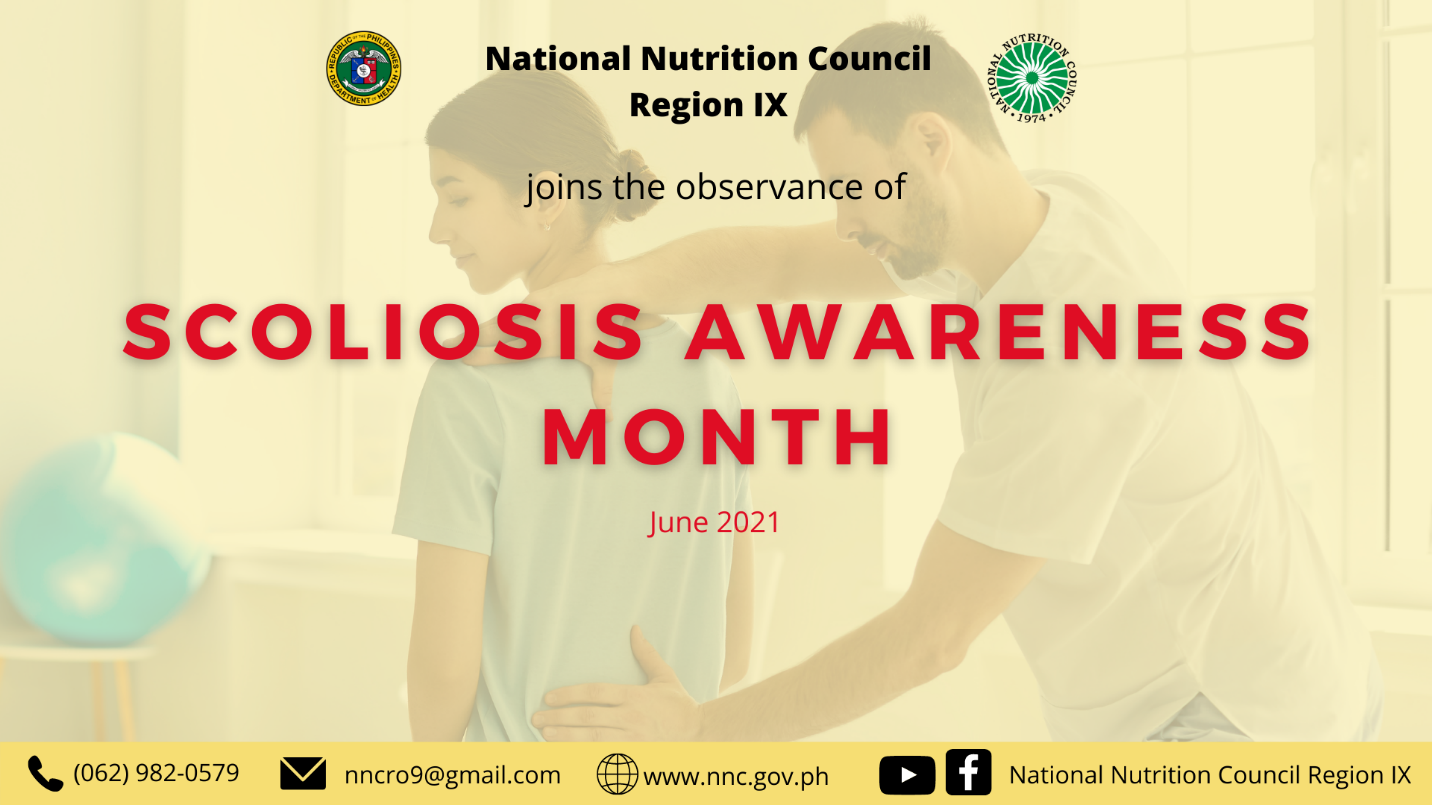
 The month of June has been declared by President Rodrigo R. Duterte as the “Scoliosis Awareness Month” with the issuance of Proclamation No. 620. This is to raise awareness of the structural disorder of the body called “Scoliosis” and to promote its early detection for immediate management. The proclamation also designates the Department of Health (DOH), in coordination with relevant non-government organizations, to promote the observance of Scoliosis Awareness Month, and to identify programs, projects, and activities for the yearly celebration.
Scoliosis is the sideways curvature of the spine that occurs most often during the growth spurt just before puberty. The normal shape of a person’s spine includes a curve at the top of the shoulder and a curve at the lower back. If your spine is curved from side to side or in an “S” or “C” shape, you might have scoliosis. Early detection and referral to appropriate healthcare providers is important, especially because this condition can severely affect the physical and psychological health of the patient.
Scoliosis is not always noticeable. However, this condition is most common in the later stages of childhood or the early teenage years. Fortunately, childhood and adolescent scoliosis is mild and does not need treatment. The most common symptoms of scoliosis include:
a) the head may appear a bit off center
b) the ribs on each side may be slightly different heights
c) one hip may be more prominent than the other
d) the clothes may not hang evenly
e) one shoulder or shoulder blade may be higher than the other
f) the person may lean to one side
g) the legs may be slightly different lengths
If you notice that you have one or two symptoms of Scoliosis, it is best to go to a doctor for a physical check-up and further examination. It is also ideal to see a physician aside from consultation but for one to be informed on the dos and don’ts when you have scoliosis. Usually, with a curve of 10 to 25 degrees, the doctor will conduct checkups every 3 or 6 months. For a 25 to 40-degree curve, the doctor may recommend bracing. For more than a 40-degree curve, and the skeleton is still immature, a doctor may recommend surgery.
Always remember, early treatment can help prevent future complications. Thus, it is best to go to a doctor to assess your condition for early and immediate management.
NO I Cielo Katrina M. Mabalot
References:
1. “Everything you need to know about Scoliosis” from https://www.healthline.com/health/scoliosis
2. “Duterte declares June as ‘Scoliosis Awareness Month’” from https://www.pna.gov.ph/articles/1053691#:~:text=Duterte%20has%20declared%20the%20month,and%20promote%20its%20early%20detection.