


 Nowadays, many consumers choose to buy prepackaged/processed food products because it has cheaper price, on trend, on sale and it’s easy to prepare and is ready to cook. With this trend, the trade of processed food consumption in the country is increasing, and this is very alarming not because it’s unhealthy (it also has a little of nutrients) but because they choose the wrong one without reading and understanding its nutritive value content. Since some consumer would only look at labels for the main reason of, to look at the price and other includes looking at the expiration date and/or the packaging itself.
Thus to ensure the health of the consumers, one effective way is to provide information about the food products through its label specifically the “Nutrition Facts Label”. Nutrition facts label is the most readily available material to inform the consumers about the content showing what nutrients and other ingredients are there in the food, making it easier to compare the nutrient content of the similar products.
In the Philippines, Nutrition Facts or Nutrition Information are regulated by the Food and Drug Administrative (FDA) as mandated by the Administrative Order No. 2014-0030 or otherwise known as the “Revised Rules and Regulations Governing the Labelling of Prepackaged Food Products Further Amending Certain Provisions of Administrative Order No. 88-B series of 1984” or the “Rules and Regulations Governing the Labelling of Prepackaged Food Products Distributed in the Philippines”. These nutrition facts are presented in tabular form, declaring the nutrient content which includes protein, carbohydrates, fats, sodium, calories and the added fortified vitamins per serving of the food.
When looking at the Nutrition Facts label, first is to check the “Number of servings” and the “Serving size” per container that is located at the top portion. Serving size is a standard amount of a food provided in basic household measurements, such as cups/ pieces/ ounces and followed by the metric amount in grams which make it easier for consumers to compare similar foods. The serving size reflects the amount that consumers typically eat or drink, but it is not a recommendation of how much you should eat or drink.
Next is, check out the “Total Calories”. Calories provide a measure of how much energy you get from a serving of food. But here’s the tricky part, the calories in the prepackaged product are per serving. It means that if you consume the entire product which accounts for 3 servings (for example), meaning you would consume 3 times of the calories of the prepackaged product. To avoid this, consumers should note of the serving size and calories to avoid also getting extra calories that is linked to overweight and obesity.
The next nutrition facts information section is about the “Specific Nutrients Amount” in the product per serving. In this section, it shows what prepackaged foods that contain more of the nutrients you want to get more of and less of the nutrients you want to limit. Thus, the nutrients to get less of are Saturated fat, Sodium and added Sugars and nutrients to get more of are Dietary fiber, vitamin D, Calcium, Iron and Potassium.
Lastly, the “Percent Daily Value (%DV)” for not locally manufactured food products or the “Percent Recommended Energy and Nutrient Intake (%RENI)” for locally manufactured food products in the Philippines. The %DV or %RENI helps determine if a serving of food product contains high or low nutrient value in which it contributes to the total daily diet.
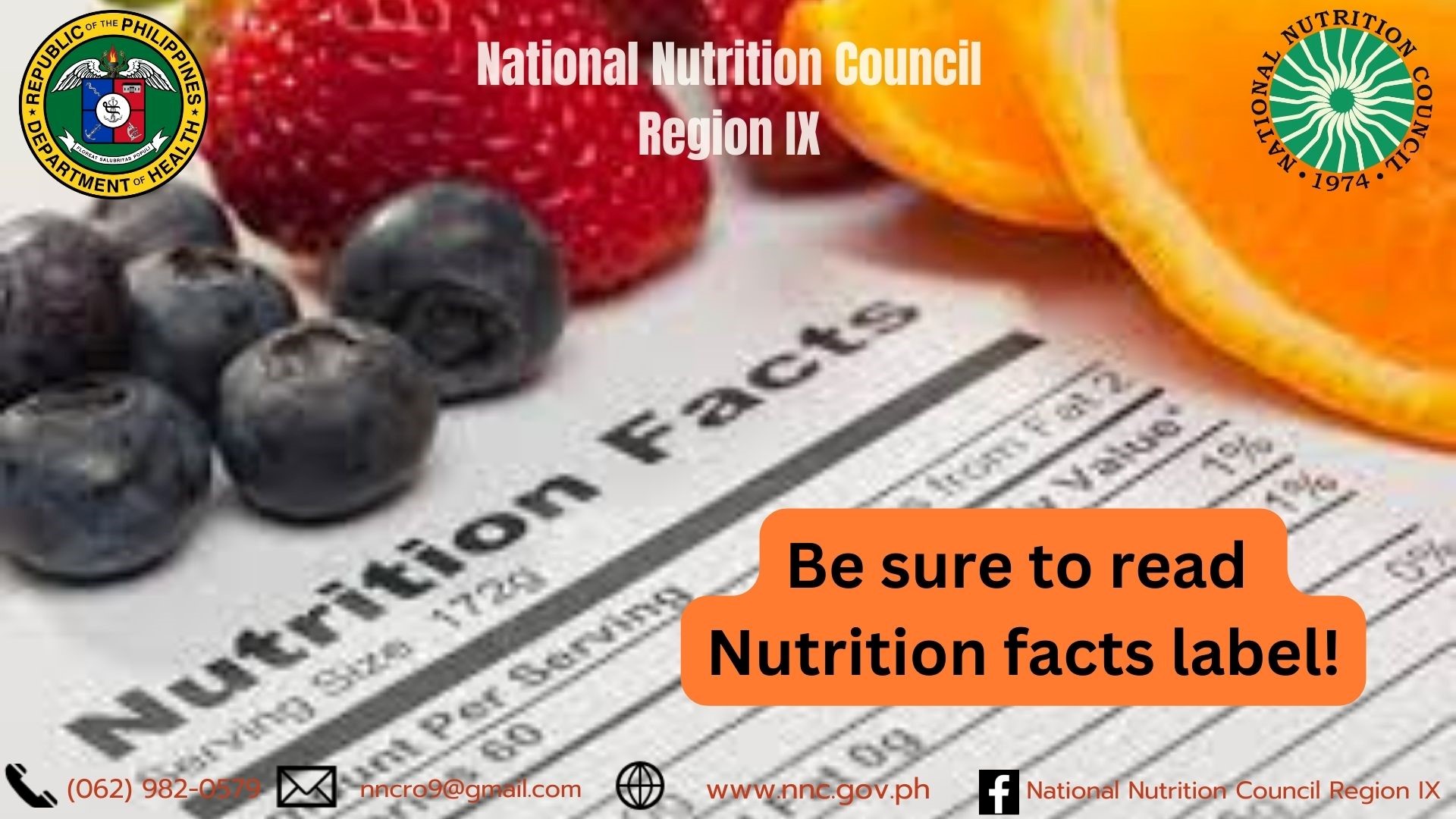
Be sure to read Nutrition facts label and compare different brand of the same food to make sure you’re getting the right one as nutrition information can really differ a lot. This will help to maintain better food choices and habits that will ensure your daily meal plan is serving healthy foods to your body. Well informed food choices accounts to a healthy diet.
DMO II-ZS, Karla P. Calapardo, RND
References:
- How to understand and use the Nutrition facts label.
https://www.fda.gov/food/new-nutrition-facts-label/how-understand-and-use-nutrition-facts-label
- Administrative Order No. 2014-0030
https://www.fda.gov.ph/administrative-order-no-2014-0030-a/
- Summary of Philippine Dietary Reference Intakes (PDRI)
https://www.fnri.dost.gov.ph/images/images/news/PDRI-2018.pdf