


 What comes to mind when you think about self-care? Do you think about staying in bed and indulging in a tub of ice cream, or binge eating junk food while watching a movie? Taking care of yourself doesn’t only mean fulfilling temporary wants. It means deciding to invest in your health so that you can boost your well-being not only for the next hour but for the rest of your life.
One way to take care of yourself is by protecting your heart. The human heart is an organ that pumps blood throughout the body; it delivers oxygen and nutrients to the tissues and carries away metabolic waste. The heart is one of the most important parts of the body because once it stops functioning, the body begins to shut down as well.
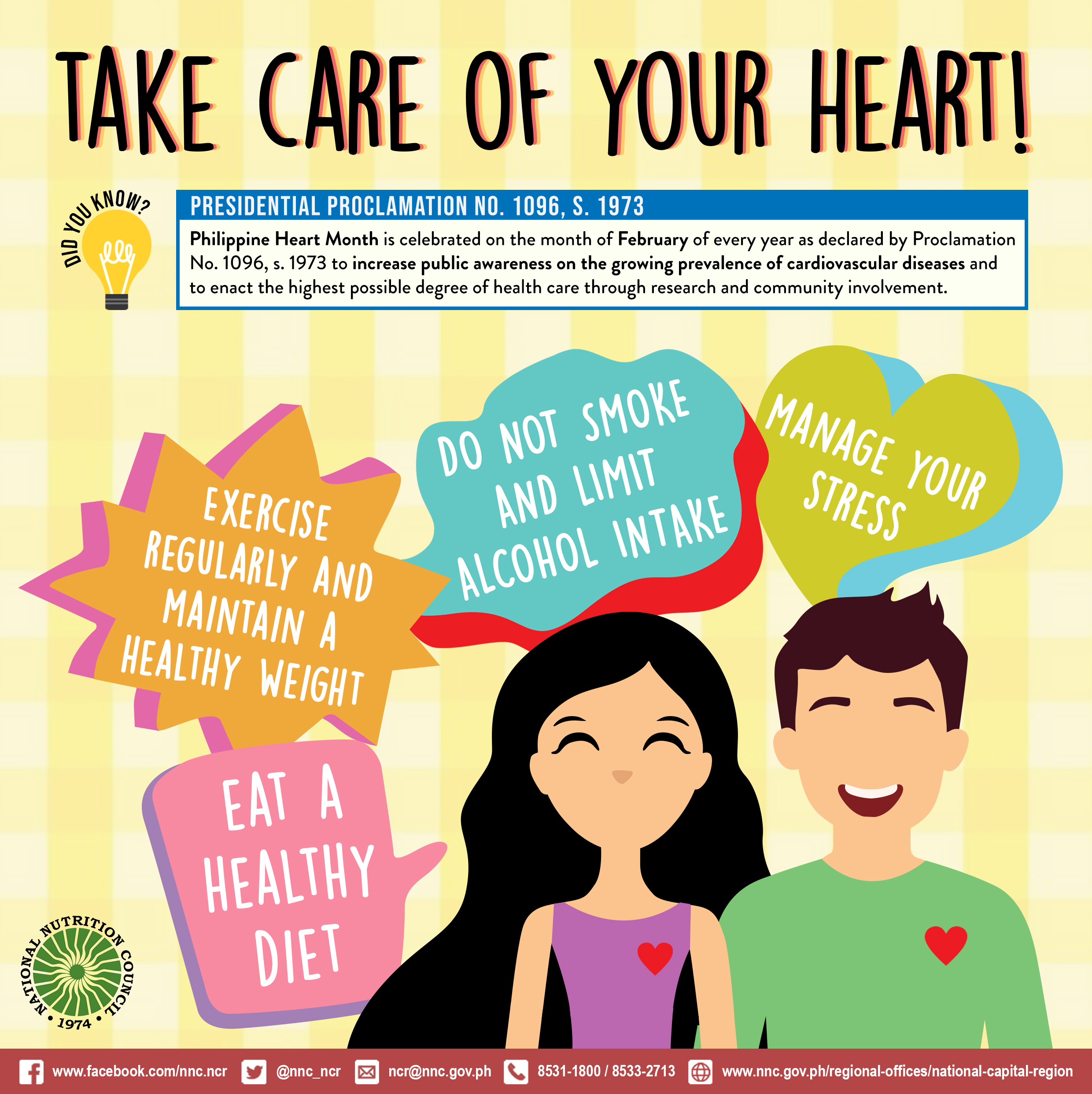
Philippine Heart Month is celebrated on the month of February of every year as declared by Proclamation No. 1096, s. 1973 to increase public awareness on the growing prevalence of cardiovascular diseases and to enact the highest possible degree of health care through research and community involvement.
Burden of non-communicable diseases in the Philippines
Why is there a need for a heart month in the Philippines? According to the World Health Organization (WHO), 6 out of 10 deaths (67%) in the country in 2016 were caused by non-communicable diseases (NCDs). During the same year, cardiovascular diseases (CVDs) or diseases of the heart and vascular system were responsible for 35% of all deaths. Among the top 10 causes of death in the Philippines, four (4) were CVDs. In 2010, hypertension or increased blood pressure was ranked 4th among the leading causes of sickness.
Risk factors for heart disease
The first step in protecting your heart is knowing if you are at risk. Non-modifiable risk factors such as age, family history, and sex play a significant role in determining your risk for developing CVD. Risk increases with increasing age and with significant family history of the disease. Men are also more likely to develop CVD than women.
On the other hand, there are risk factors that can be modified and controlled, such as cholesterol levels, diabetes, lifestyle habits, and obesity.
Having high levels of “bad cholesterol” or low-density lipoproteins (LDL) in the bloodstream increases the risk for developing CVD. Increased blood cholesterol may cause build-up and clog arteries, resulting in obstructed pathways that can lead to stroke or heart attack. People who have diabetes also have an increased chance of developing CVD. High amounts of glucose in the blood makes the arteries more stiff and narrow. When both blood cholesterol and blood glucose levels are increased, the heart needs to exert more effort to pump blood which leads to hypertension.
Lifestyle habits can significantly affect your heart health. Smokers are up to four times more susceptible to heart disease than non-smokers. Worse, non-smokers are affected by second-hand smoke despite their abstinence. Excessive alcohol intake increases blood cholesterol levels. Physical inactivity also puts you at risk. Prolonged sitting kills more than smoking and does so by slowing down the body’s metabolism.
There are three ways in which overweight and obesity contribute to the development of CVD: (1) by increasing levels of bad cholesterol, (2) by causing your blood pressure to rise, and (3) by being a risk factor for diabetes. According to the 2018 Expanded National Nutrition Survey (ENNS) conducted by the Food and Nutrition Research Institute of the Department of Science and Technology (FNRI-DOST), 37.2% or 3 out of 10 Filipinos aged 20-59 years are overweight and obese. Trends show that prevalence rates are increasing not only in this age group but in younger populations as well.
Ways to prevent heart disease
While we cannot control risk factors such as age, sex, and family history, CVD can be prevented by practicing healthy habits. One of the most effective ways to protect your heart is by eating a healthy diet. This means including generous amounts of fruits and vegetables in your meals and avoiding foods that can raise your blood cholesterol and blood glucose levels. The Pinggang Pinoy was developed by FNRI-DOST to serve as a visual guide for Filipinos in consuming the right amount and kind of food in every meal. This food plate model also includes descriptions on the three food groups Go, Grow, and Glow, and a sample one-day meal plan. The Pinggang Pinoy can be accessed at https://www.fnri.dost.gov.ph/index.php/tools-and-standard/pinggang-pinoy.
Fat intake must be limited to prevent unhealthy weight gain and lower risk of developing heart disease. Foods high in sodium such as processed food items, foods high in trans fat, and foods high in free sugars must especially be limited as they have little nutritive value. Difficult as it may seem, taking care of your health means saying no to deep-fried snacks, junk food, and sugar-sweetened beverages.
It is important to maintain a healthy weight and lose weight if you are overweight or obese. According to the Philippine National Guidelines on Physical Activity (PNGPA) of the Department of Health (DOH), thirty minutes to one hour of physical activity every day is recommended for adults aged 21-45 years, while a minimum of thirty minutes per day is recommended for adults aged 46-59 years. Tasks can be as simple as brisk walking and gardening. For every hour of sitting, two minutes of physical activity such as walking or climbing the stairs is highly encouraged.
To prevent the development of CVD, do not smoke and limit alcohol intake. Smoking doesn’t just affect the smoker; when you smoke around your family and friends, it damages their health too. It is best to avoid drinking alcohol but if it is consumed, a maximum of two drinks per day for men and one drink per day for women are recommended.
As we celebrate Philippine Heart Month, let us be reminded that every accomplishment starts with the decision to try. Choosing to take care of yourself might mean going through difficult changes, but these changes are necessary to becoming healthier and living a longer life. It is never too early to protect your heart. Let’s keep this year’s theme in mind: “Pusong Inaalagaan, Sakit Maiiwasan.” (RGRG/NPC MEVF/NNC-NCR)
References:
- https://www.cdc.gov/heartdisease/risk_factors.htm
- https://www.cdc.gov/tobacco/data_statistics/fact_sheets/health_effects/effects_cig_smoking/index.htm
- https://www.cdc.gov/alcohol/faqs.htm
- https://www.heart.org/en/health-topics/heart-attack/understand-your-risks-to-prevent-a-heart-attack?fbclid=IwAR1Mgd12tK1dfpcsNvnxG7VJAzc48-FBGwXiCey9FNqzW7uRLmZChoKTybo
- https://www.sciencedaily.com/releases/2015/04/150430170715.htm