


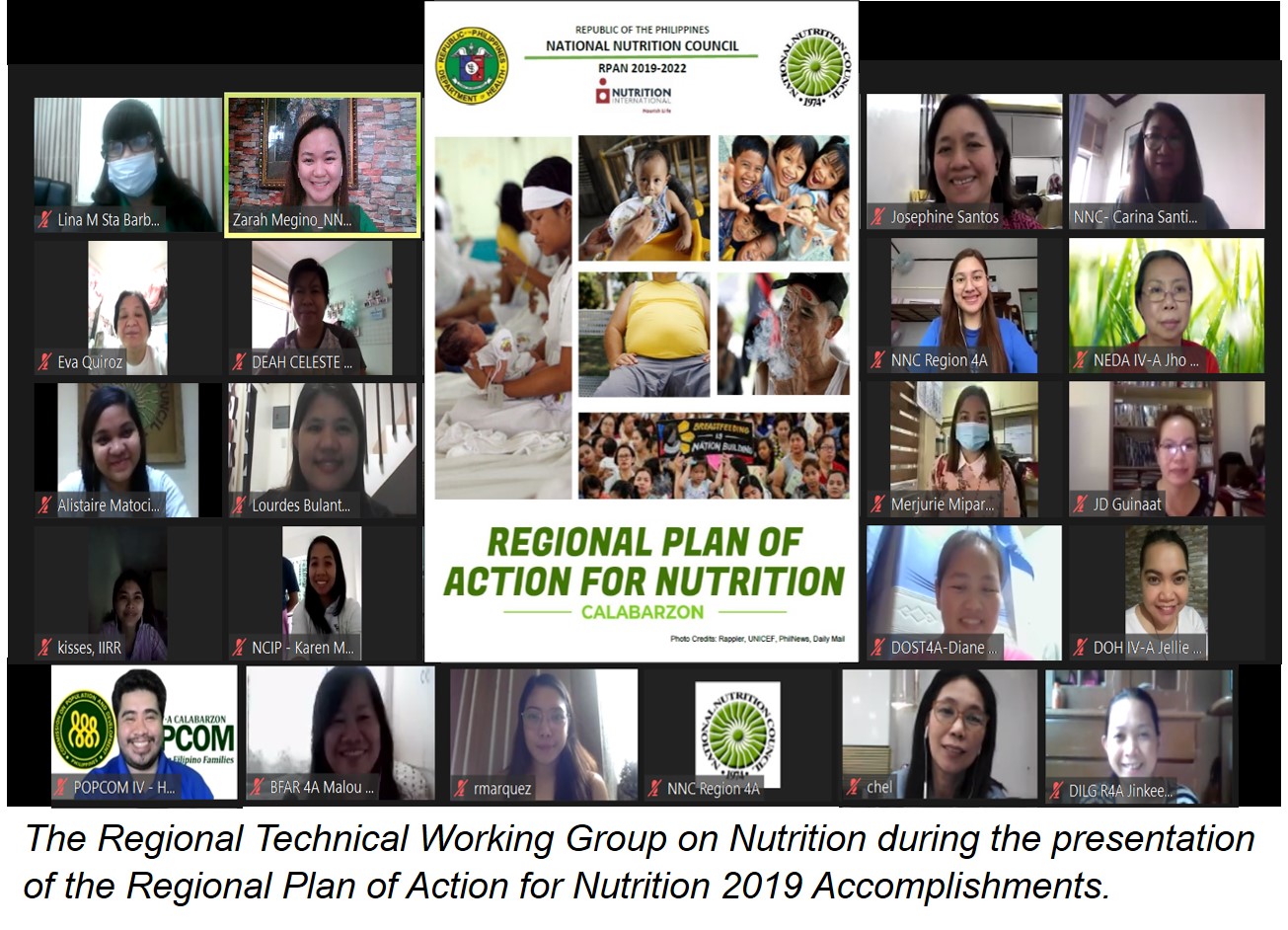
The heightened accomplishments of the Region IV-A Sector Agencies’ first year of implementation of the CaLaBaRZon Regional Action Nutrition Plan of Action for Nutrition (RPAN) in 2019 — have strengthened the fight against malnutrition and has continuously pursued the attainment of the Philippine Nutrition Plan of Action for Nutrition (PPAN) 2017-2022 targets.
Capacity building Activities. Highlighting the accomplishments are the capacity building activities conducted by DOH IV-A to promote, protect and support safe motherhood and breastfeeding. This is part of the First 1000 Days (F1K) Program, the key program to address stunting.
As a result, breastfeeding and complementary feeding support groups were conducted in nine (9) LGUs, including the provinces of Cavite, Laguna, Batangas and Rizal, municipalities of Los Baños and Pagsanjan and Tagaytay City – established.
In addition, an “Integrated Lactation Management Training” was conducted for LGU hospitals, and “Relactation Seminars” were given to nurses and doctors to increase the number of health and non-health facilities/establishments that are compliant to EO 51 and RA 10028. Moreover, they were able to monitor 81 health and non-health establishments.
A “Regional Conference of Nutritionist-Dietitians” to strengthen the health delivery system for F1K, the “Kalusugan at Nutrisyon ng Mag-Nanay Act (RA 11148)” was also conducted. It tackled the Implementing Rules and Regulations.
The International Institute of Rural Reconstruction (IIRR) also conducted 2 capacity building activities specifically, the Implementation of Community Nutrition Project for F1K (CNP-F1K) in Guinayangan, Quezon and “Municipal Training on Basic Nutrition & F1K” for Silang Child Development Workers
Support for Mobilization of LGUs. To support the mobilization of LGUs on F1K Program, the Regional Development Council (RDC) led by the National Economic and Development Authority (NEDA) endorsed the RPAN 2019-2022 to Regional Line Agencies (RLAs), State Universities and Colleges (SUCs), and LGUs through RDC Resolution No. IV-A-90-2019.
Banner Programs of SCSD. One of the banner programs of the Sectoral Committee on Social Development (SCSD) is the monitoring of the implementation of F1K. The updates on the implementation is regularly reported in the quarterly meetings of SCSD.
The Department of Science and Technology (DOST) adopted 2 technologies and produced nutrition products in support to the Establishment of Complementary Food Production Processing Plant Project.
In the Dietary Supplementation Program, 189,982 children in Child Development Centers (CDCs) and Supervised Neighborhood Plays (SNPs) were provided by the Department of Social Welfare and Development (DSWD) IV-A with supplementary feeding for CY 2019-2020. There were 4,998 pieces of eating utensils, 100 sets cooking materials, 200 height board and 250 weighing scales procured and distributed for Supplementary Feeding Program (SFP) beneficiaries.
Another agency which provides SFP to school children is the Department of Education (DepEd) IV-A. There were 252,933 children given “School-based Supplementary Feeding” by the agency.
Under the Community-based Supplementary Feeding for Malnourished Children Project, DSWD and Kabisig ng Kalahi identified and launched modules to the identified LGUs implementing community-based feeding for malnourished children. Both agencies assisted the LGUs in the implementation of feeding and provided technical assistance regarding the program during monitoring. IIRR reproduced and distributed “Katutubong Gulay Recipes” of CNP-F1K, a recipe booklet for complementary feeding using indigenous crops.
Furthermore, a delivery system for Philippine Integrated Management on Acute Malnutrition (PIMAM) was established in Batangas Medical Center, a DOH Regional Hospital. DOH also conducted orientation on PIMAM and Training on the Establishment of Nutriward in hospitals and out-patient centers in RHU for severely malnourished children.
More Commitment to Support Nutrition-Sensitive Programs. Several agencies committed to support the Nutrition-Sensitive Programs. One is the Bureau of Fisheries and Aquatic Resources (BFAR) IV-A which conducted nutrition education to 789 fisherfolks. 18 techno-demo projects were also provided to fisherfolk families with malnourished children. Another agency that led nutrition-sensitive PPA is the Department of Environment and Natural Resources (DENR) IV-A. 75 families from 3 LGUs benefited in their Livelihood Agro-forestry Project.
The Department of Labor and Employment (DOLE) showed its support through the promotion of “Lactation Stations” in the workplace by conducting 2 lactation seminars and serving as Resource Speaker during the “Ala Eh! Hakab na Dine 2019” in Batangas City. They also monitored the temporary lactation room at Team Energy Corporation 5th Office Clinic, Pagbilao, Quezon and OHS Clinic.
DOST conducted 17 training activities and assisted 479 families under the Community Empowerment through Science and Technology (CEST) which targets nutritionally depressed municipalities and families with malnourished children.
Moreover, 12 agrarian reform beneficiary households were provided with livelihood and nutrition related interventions by the Department of Agrarian Reform (DAR) IV-A. Under the Village Level farm Focused Enterprise Development (VLFED) Project, 13 Agrarian Reform Beneficiary Organization or ARBOs participated as regular supplier of the products and managed Enterprise adopting food fortification.
IIRR also provided native pig and chicken to 380 families and vegetables seeds, fruit trees, root and tuber crops planting materials to 330 farming families.
Under the Policy Development for Food and Nutrition Project of the Enabling Program, RDC endorsed and passed 5 resolutions supporting the improvement of nutrition in the region.
The Commission on Population and Development (POPCOM) trained 400 peer facilitators and 1,753 school-age participants on U4U Teen Trail. 100 peer educators were organized, and 301 parents were oriented in “Learning Package for Parent Education on Adolescent Health and Development (LPPEAHD).” There were 5,527 “Responsible Parenting and Family Planning (RPFP)” classes conducted and 620 participants KATROPA or “Kalalakihang Tapat sa Responsibilidad at Obligasyon sa Pamilya” were trained.
DOH was able to train 22 LGUs on the management of acute malnutrition during emergencies.
Upgrading of IEC Platforms. In order to further upgrade and support nutrition and health programs, NNC together with Communicators’ Network for Nutrition in Region IV-A (CNN IV-A) and Philippine Information Agency used various platforms such as radio, social media and IEC materials. The radio stations in CaLaBaRZon including Radyo Kaisahan 107.7
MHz of Sariaya, Quezon and other local radio stations in Lucena City and Calamba City aired 4 nutrition radio programs which includes 52 episodes of “Katumbas ay Biyaya Season 10”, 48 episodes of “One Nutrition One Nation (ONON) Radio Program”, 11 radio plugs of “10 Kumainments”, and “Radyo Mo sa Nutrisyon Radio Program”.
Another platform used for communication is the Nutri Komiks. A new series was developed and released in 2019 which is the 6th series: “Nutrition for Elderly”
Accomplishment Reports. There were eleven (11) members of the RSCN who submitted the status of implementation of their commitments for the year 2019 (specifically in the Nutrition Specific and Nutrition Sensitive programs). The accomplishments were consolidated and presented during the 1st Regional Sub-Committee in Nutrition (RSCN)/Regional Technical Working Group (RTWG) Meeting.
RPAN is a plan that commits regional sector agencies to action and resources to contribute to their proportionate share of the malnutrition burden and corresponding targets in the PPAN. The achievement of its goal depends on the accomplishment of every commitment of the agencies. Every year of successful implementation will bring the region towards a better nutrition condition.
The drafting of the plan started in March 2018 where all members of the Regional Sub-Committee in Nutrition (RSCN) were gathered to create strategies in response to the alarming nutritional problem in the region. This was followed by a series of meetings until the plan was finalized and adopted in December 2018.
By: Mary Emerene P. Pingol