


 In the Philippines, the words “high blood” often appear in conversation. When used in this manner, it is to express feelings of anger and frustration. But, scientifically-speaking, do we know what it actually means?
To pump blood throughout the body, the heart exerts force which is measured as the blood pressure. When the heart exerts a force higher than normal, blood pressure increases which leads to hypertension.
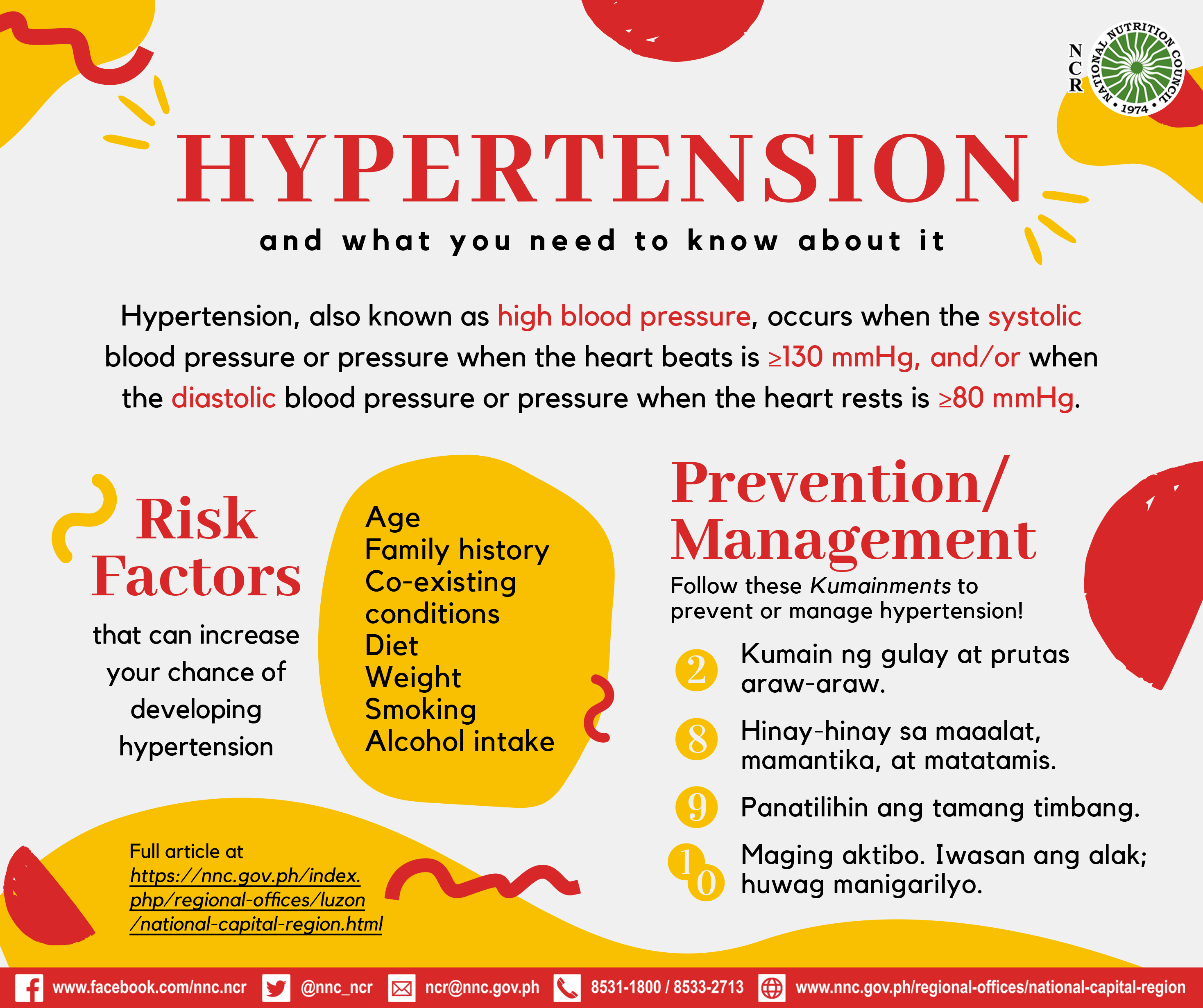
World Health Organization defines hypertension or high blood pressure as a serious medical condition that significantly increases the risks of heart, brain, kidney and other diseases. Blood pressure is high when the systolic blood pressure or pressure when the heart beats is greater than or equal to 130 mmHg, and/or when the diastolic blood pressure or pressure when the heart rests is greater than or equal to 80 mmHg.
According to the 8th National Nutrition Survey conducted by the Food and Nutrition Research Institute of the Department of Science and Technology (FNRI-DOST) in 2013, 2 out of 10 (22.3%) adult Filipinos are hypertensive. Prevalence rates have not significantly changed over the last 27 years: 22.0% in 1993, 21.0% in 1998, 22.5% in 2003, and 25.3% in 2008.
To raise awareness and to ensure that different strategies in the prevention, treatment and control of hypertension be actively pursued, May of each year was declared as Hypertension Awareness Month by virtue of Presidential Proclamation No. 1761, s. 2009.
Who are at risk? There are non-modifiable and modifiable factors that may put you at a higher risk of developing hypertension.
Non-modifiable risk factors are factors beyond your control, such as age, family history, and co-existing diseases. Risk increases with age; males above 40 years old and females at a menopausal age, which is 48 years old on average for Filipino women, have an increased risk of developing hypertension. Having a history of hypertension in the family puts you at risk. Co-existing conditions such as diabetes mellitus or kidney disease may also result in elevated blood pressure.
Having any of the mentioned risk factors does not mean that you will automatically develop hypertension; there are other risk factors that can be modified and controlled through lifestyle changes.
Your diet plays a significant role in shaping your health. Too much sodium in the diet increases blood volume in the bloodstream. This means that the heart needs to exert more effort to pump blood throughout the body, resulting in elevated blood pressure. Excessive intake of saturated and trans-fat may also lead to hypertension by increasing levels of bad cholesterol and decreasing levels of good cholesterol in the body. Increased bad cholesterol levels may cause build-up, eventually clogging arteries and hindering blood flow.
Putting on additional weight also puts extra strain on the heart. Individuals who are overweight or obese are more likely to develop hypertension than those who are at their desirable body weight. Results of the 2018 Expanded National Nutrition Survey (ENNS) conducted by FNRI-DOST show that 37.2% or 3 out of 10 Filipinos aged 20-59 years are overweight and obese, which poses a public health problem.
Cigarettes contain nicotine, a substance which hardens arterial walls and increases the likelihood of blood clots. Every time you smoke, your blood pressure temporarily increases. With habitual smoking, the effects are multiplied many times over, allowing the heart to bear the unnecessary burden of exerting more force than necessary just to be able to pump blood. Excessive alcohol intake also raises blood pressure by increasing levels of bad cholesterol in the blood, eventually causing build-up of fat in the arteries.
What are the signs and symptoms? Hypertension has been deemed the “silent killer” because of the absence of symptoms upon its onset. On some occasions it manifests as headache, dizziness, blurred vision, nausea and vomiting, or chest pain and shortness of breath. However, an increase in blood pressure can easily be identified through the use of a blood pressure apparatus.
How does hypertension affect health? If hypertension is not managed, it may lead to more serious complications. One of the effects of increased blood pressure is the hardening of arteries which causes problems in blood circulation. The heart then fails to receive adequate amounts of nutrients and oxygen. This may result in poor outcomes such as chest pain, heart attack, heart failure, and even death. Hypertension may also affect organs such as the brain and kidneys, eventually causing stroke and kidney failure, respectively.
How can it be prevented/managed? Lifestyle changes not only prevent and reduce the burden of hypertension but they also enhance overall well-being and decrease the likelihood of poor health outcomes.
A nutritious, well-balanced diet is needed to prevent hypertension and unhealthy weight gain. Kumainment number 8 says: “Hinay-hinay sa maaalat, mamantika, at matatamis.” Limit fat and sodium intake by avoiding processed food items, junk food, and deep-fried snacks. Foods with high sugar content must also be limited because of its lack of nutritive value. In addition to this, Kumainment number 3 says: “Kumain ng gulay at prutas araw-araw.” Include adequate amounts of fruits and vegetables in your diet by following the Pinggang Pinoy. This tool was developed by FNRI-DOST to serve as a visual guide for Filipinos in consuming the right amount and kind of food in every meal, which can be accessed at https://www.fnri.dost.gov.ph/index.php/tools-and-standard/pinggang-pinoy.
Strive to attain or maintain your desirable body weight through regular exercise. Kumainment number 9 says: “Panatilihin ang tamang timbang.” The Philippine National Guidelines on Physical Activity (PNGPA) of the Department of Health (DOH) recommends at least thirty minutes to one hour of physical activity daily for adults aged 21-45 years, while a minimum of thirty minutes daily for adults aged 46-59 years. Physical activity does not necessarily mean going to the gym and lifting weights; it can be as simple as walking up and down your street or watering the plants.
Avoid smoking and limit your alcohol intake – letting go of today’s pleasures might mean securing more tomorrows. Kumainment number 10 says: “Maging aktibo. Iwasan ang alak; huwag manigarilyo.” It is never too late to quit smoking. Breathing becomes easier as early as 72 hours after the last cigarette. If you are not a smoker, remember to avoid secondhand smoke as it may also put your health at risk. It is best to avoid drinking alcohol but two drinks per day for men and one drink per day for women may be allowed.
Yes, hypertension may progress into more severe outcomes, but it can also be easily prevented and managed. Changing your lifestyle will not happen overnight. To sustain behavior change, it is best to take small but significant steps. Choosing to take care of your health not only shows how you value yourself but also shows your loved ones that you are investing in a future with them. (RGRG/NPC MEVF/NNC-NCR)
References
- Department of Health (DOH). (2012). Philippine Health Advisories.
- https://www.who.int/news-room/fact-sheets/detail/hypertension
- https://www.heart.org/en/health-topics/high-blood-pressure/why-high-blood-pressure-is-a-silent-killer/know-your-risk-factors-for-high-blood-pressure
- https://www.hsph.harvard.edu/nutritionsource/salt-and-sodium/
- https://www.healthline.com/health/high-cholesterol/treating-with-statins/hypertension#1
- https://www.acc.org/latest-in-cardiology/articles/2017/11/08/11/47/mon-5pm-bp-guideline-aha-2017
- https://my.clevelandclinic.org/health/articles/11870-why-should-i-quit-smoking
- https://www.officialgazette.gov.ph/2009/05/01/proclamation-no-1761-s-2009/