


 #AllAboutPPAN
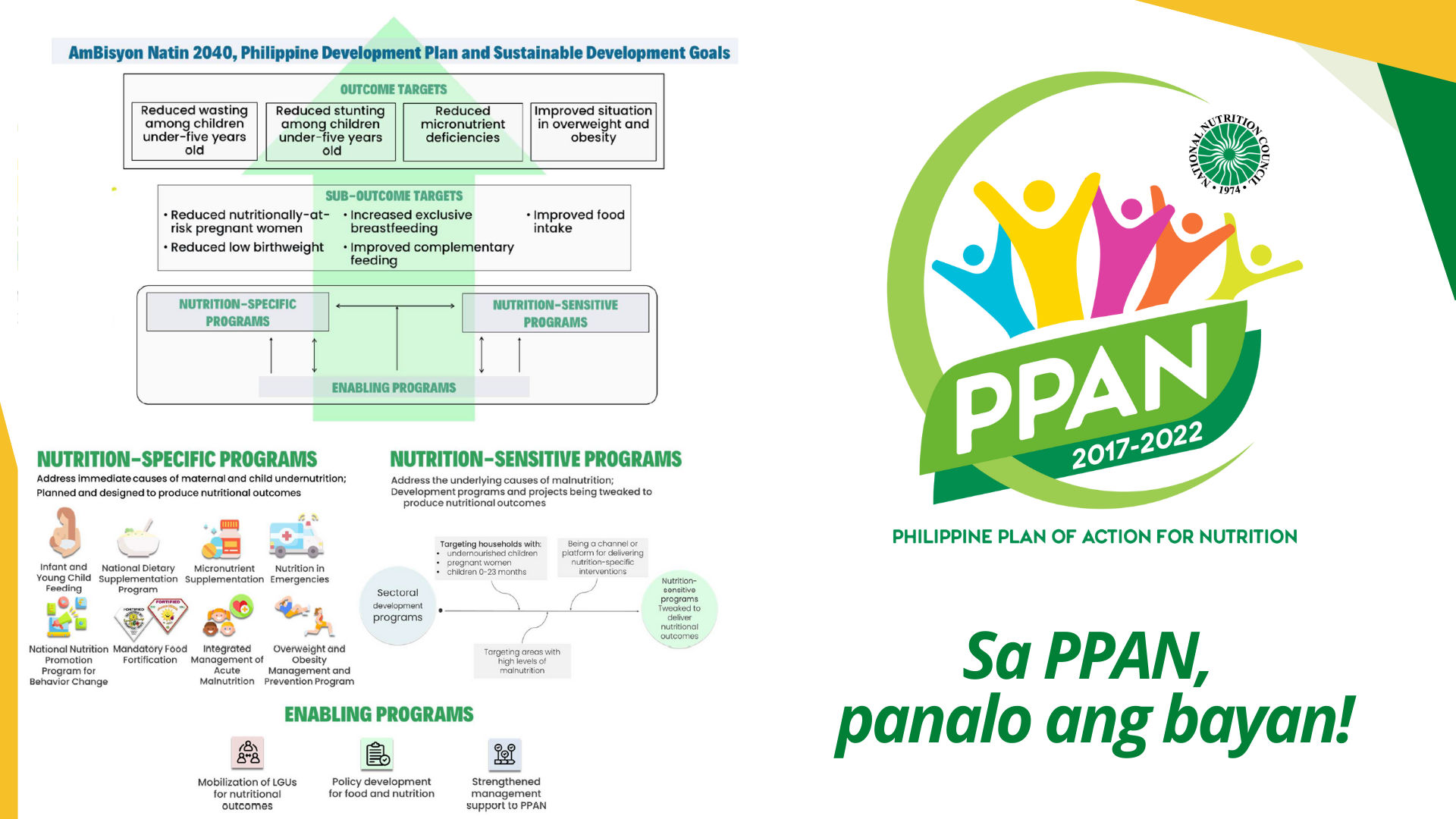
The Philippine Plan of Action for Nutrition or PPAN is the country’s framework to address the problem of malnutrition and is formulated by the National Nutrition Council (NNC). It is a companion plan of the Philippine Development Plan (PDP). It layouts the targets, directions, and priority actions to address wasting, stunting, micronutrient deficiencies, and overweight and obesity. (Know more about NNC: https://www.nnc.gov.ph/regional-offices/luzon/national-capital-region/7202-be-one-of-the-spoons-national-nutrition-council-s-call-for-nutrition-improvement)
Various forms of malnutrition are still present in the country. Through the collective action of stakeholders, the PPAN aims to reduce wasting and stunting among children under five years old. Wasting is an acute form of malnutrition wherein children have low weight for length/height. On the other hand, stunted children are short for their age. Stunting reflects chronic undernutrition and its effects are irreversible.
The PPAN also aims to reduce deficiencies in micronutrients such as vitamin A, iron and iodine and improve situation in overweight and obesity. Its sub-outcome targets include the reduction in the number of nutritionally-at-risk pregnant women and low birthweight babies, increase in exclusive breastfeeding and improvement in complementary feeding and food intake.
The achievement of the PPAN targets will contribute to the realization of Ambisyon Natin 2040 and attainment of the PDP goals, Sustainable Development Goals (SDG), and the 2025 World Health Assembly (WHA) targets.
To achieve the PPAN outcome and sub-outcome targets, the PPAN has three (3) pillars namely, nutrition-specific programs, nutrition-sensitive programs, and enabling programs.
Nutrition-specific programs are programs that address the immediate causes of maternal and child undernutrition. The following are the eight (8) nutrition-specific programs of the PPAN:
- Infant and Young Child Feeding
- Integrated Management of Acute Malnutrition
- National Dietary Supplementation
- National Nutrition Promotion Program for Behavior Change
- Micronutrient Supplementation
- Mandatory Food Fortification
- Nutrition in Emergencies
- Overweight and Obesity Management and Prevention
On the other hand, nutrition-sensitive programs address the underlying causes of malnutrition. These are development programs and projects that are modified or tweaked to produce nutritional outcomes. Tweaking can be done by targeting households with undernourished children, pregnant women and children 0-23 months, targeting areas with high levels of malnutrition and being a channel or platform for delivering nutrition-specific interventions.
Enabling programs are support programs to ensure that nutrition-specific and nutrition sensitive programs are well-implemented. These include the mobilization of local government units for nutritional outcomes, policy development for food and nutrition, and strengthened management support to PPAN.
Nutrition is everyone’s business. Eradicating malnutrition requires multisectoral, collective action and that is what the PPAN logo represents. The circle and group of human figures in different colors show united action by people from different sectors and levels, and agencies working together to address malnutrition.
Sama-sama natin wakasan ang malnutrisyon. Sama-sama nating isulong si PPAN, dahil sa PPAN, panalo ang bayan!
Stay tuned to the National Nutrition Council’s webpage to know more about the PPAN through #AllAboutPPAN.
Click the link below for the NutriSerye: Usapang Nutrisyon, atbp. Year 2 – Episode 1: Getting to know the National Nutrition Council and the PPAN: https://www.facebook.com/nnc.ncr/videos/563831978026838
Written by: NO II Theresa A. Rivas and NPC Milagros Elisa V. Federizo