


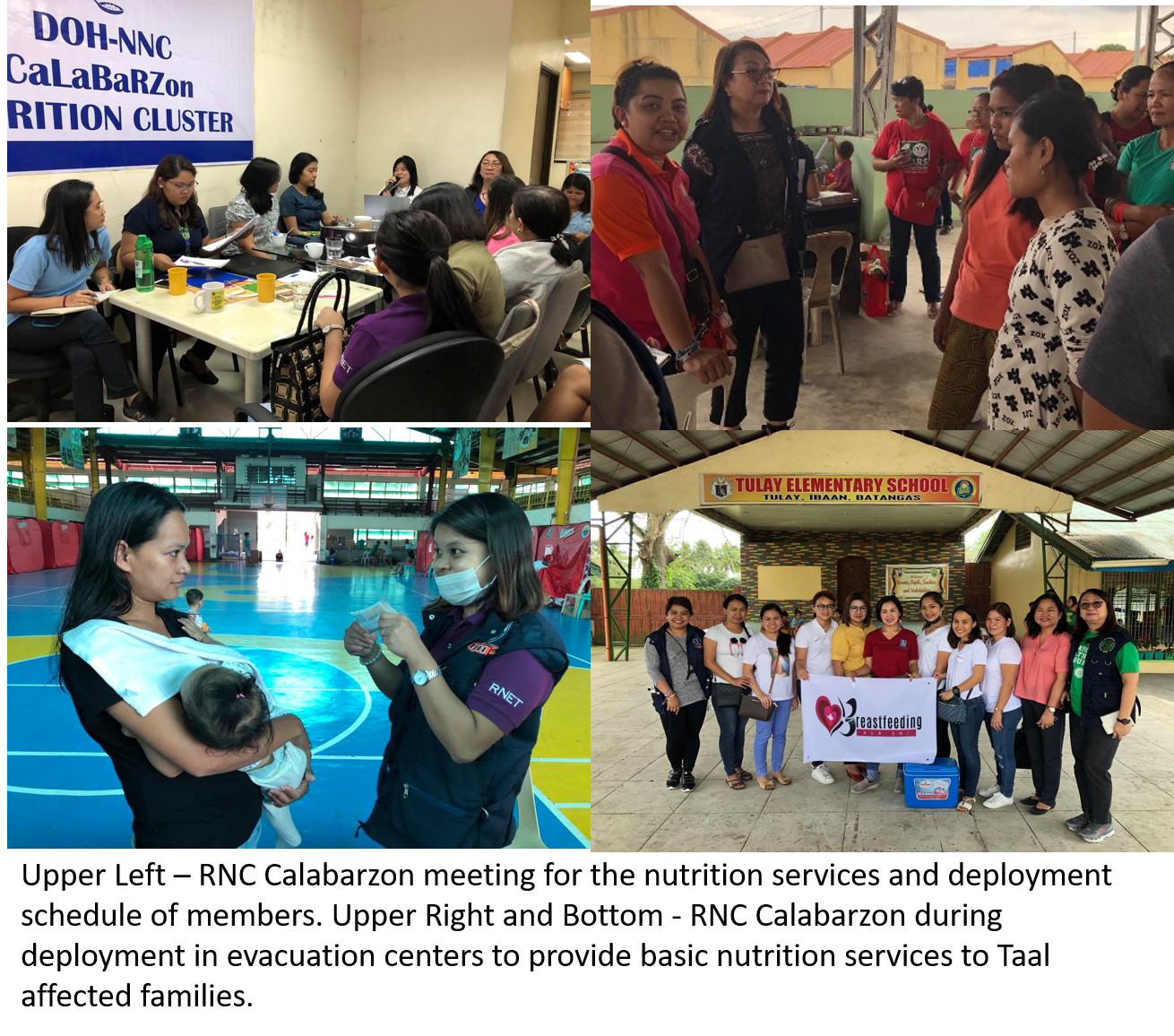
 The recent Taal Volcano Eruption took the Calabarzon region by surprise, but its Health Cluster and its Regional Nutrition Cluster (RNC) has been preparing for the event since December last year. The nutritional problems that inevitably follow food shortages during emergencies and disasters was clearly foreseen such that a Nutrition in Emergencies (NiEM) Plan 2019-2022 was put into place at the most appropriate time. The Plan was the main tool used to reduce the impact of the Taal Volcano Eruption.
As one of the quad clusters belonging to the Health Cluster, the RNC acts as the prime mover in ensuring that the nutrition situation of affected population will not worsen in times of emergencies and disasters. The RNC is composed of representatives from the regional offices of DOH, DSWD, DILG, DA, DepEd, DTI, DOST, NEDA, OCD, DOLE, DENR, DAR, DBM, BFAR, PIA, PopCom, NCIP, TESDA, NFA, and NGOs (Kabisig ng Kalahi, Regional Rural Improvement Club (RRIC) and Nutrition Foundation of the Philippines (NFP) and NNC Calabarzon as the Cluster Coordinator.
Activation of Nutrition Clusters Using the NiEM Plan
The 1st RNC Meeting for 2020 was called by NNC CaLaBaRZon in January 15, 2020 to activate the Nutrition Cluster using the NiEM Plan. It discussed the following: prioritization, scheduling and deployment of RNC members in the affected areas and evacuation centers (ECs); the use of the Capacity Map in determining available trained nutrition responders and available commodities prepositioned by LGUs; and review of the Nutrition Initial Needs Assessment (NINA) tools. Several meetings of the RNC proceeded for discussions of actions taken by the deployed teams, issues and concerns and recommended actions.
On the 3rd day of the disaster, the number of affected population reached a total of 4,875 families and 24,092 individuals in 2 provinces of the region, with a total of 83 evacuation centers. Nevertheless, the RNC was able to cope with the problem of how to cover all the evacuation centers with trained personnel who will deliver nutrition interventions to the affected population, as well as budget for mobilization of these teams.
The RNC also managed the deployment of 2-3 teams a week, and were able to cover a total of 67 evacuation centers in the 5 weeks of deployment with the help of the National Nutrition Council–Central Office and the Department of Health–Calabarzon. These agencies released funds for the deployment of staff. Also providing the much-needed staff complement for the RNC were NNC and DOH staff from Regions I, CAR, II, III, Mimaropa, NCR and from the NNC Central Office.
A total of 67 ECs were visited during the duration of deployment which were mostly in Batangas and Cavite Province. These, however, were complemented by staff deployed by the local nutrition clusters at the provincial, city and municipal levels.
Nutrition Interventions
Initially, the first teams deployed conducted the Nutrition Initial Needs Assessment (NINA) to determine availability of commodities and supplies in the ECs such as Vitamin A capsules, Ready to Use Supplementary Food (RUSF)- Plumpy Sup and Plumpy Mum, Ready to Use Therapeutic Food (RUTF), Micronutrient Powder, measuring tools, and IEC materials. The NINA tool also provided the demographic data of the nutritionally vulnerable groups such as the 6-59 months old children, pregnant and lactating women, and elderly. It also aimed to determine if various nutrition interventions have already been given to targeted groups, as well as efforts being implemented in the ECs, and most importantly, the issues and challenges faced by the local implementers.
With the results of the NINA processed by the RNC, nutrition services were then effectively provided which include: conduct of nutrition assessment to determine the Wasted Children and at-risk Pregnant women needing supplementary feeding; Nutrition Counselling to Mothers; Provision of Vitamin A capsules to children 6-59 months old; and provision of RUSF/RUTF to those identified Moderately Acute Malnourished (MAM) and Severely Acute Malnourished (SAM) children and nutritionally at-risk pregnant and lactating women.
The team also gave IEC materials to the evacuees including Nutri-Komiks Series 1 which talks about Exclusive Breastfeeding, Series 2 about Nutrition in Emergencies, Series 3 about Complementary Feeding and Series 6, Healthy Diet for Senior Citizens. Rural Health Centers (RHU) and EC are also given Breastfeeding Tarpaulins, IYCF Flipcharts and stocks of nutrition commodities. Also monitored were mother-baby friendly spaces and inspected if there were any formula milk donations.
Issuance of Policies
To further strengthen policies and actions relative to the nutrition response for the Taal Volcano eruption victims, RNC member agencies such as DOH and DILG released issuances on breastmilk substitute donations and use of MNP and other nutrition commodities.
DOH issued the following Advisories: Advisory on the guidelines for IYCF-E for evacuation centers relative to the eruption of the Taal Volcano in the Province of Batangas; Advisory No. 2020-2 regarding the use of MNP in the distribution of meals in the evacuation centers; Advisory No. 2020-3 which tackles guidelines on the acceptance of infant formula, breastmilk substitutes, feeding bottles, artificial nipples and teats during emergency and disaster situations and; Advisory on the guidelines for the extended use of RUSF and RUTF in evacuation centers and displaced communities relative to the eruption of the Taal Volcano.
Meanwhile, DILG issued a memorandum on the acceptance of breastmilk substitute donations during emergency and disaster situations, highly discouraging LGUs on the acceptance of breastmilk substitute donations.
Building Local Capacities
The RNC, in its efforts to ensure that needs are met in each of the evacuation centers, provided technical support during the reactivation of Provincial Nutrition Clusters. Thus, it managed to visit four (4) provinces, namely: Batangas, Cavite, Quezon and Laguna to conduct Emergency Meetings.
The Provincial/City/Municipal Nutrition Action Officers (P/C/MNAOs) and Barangay Nutrition Scholar (BNS) Presidents were invited to join the meetings, which aimed to discuss the problems encountered by each province/city/municipality in evacuation centers while the RNC presented the results of the NINA, the activities and services done by the region. Continuous assistance is given by RNC to our Local Nutrition Clusters.
Information Management Officers (IMOs) from the DOH-Calabarzon and the NNC Calabarzon were also designated to ensure that reports (on nutrition services and number of wasted children and at risk pregnant women in the evacuation centers, as well as other issues and concerns) are forwarded to the DOH for info and action. These reports were consolidated from the reports of the local nutrition clusters as well as the teams deployed by the RNC.
Assistance from Partners
The RNC also established partnership with different organizations to provide technical assistance and IEC materials during the disaster response. Amongst the identified partners were UNICEF, International Institute for Rural Reconstruction (IIRR) and Feed the Children. Unicef, aside from providing technical assistance to the RNC, has committed to provide funds for the hiring of an Information Management Officer. The IIRR pledged to search for donors for the establishment of mother-baby friendly space and community Nutri-kitchen in evacuation centers while Feed the Children committed to assist the RNC in organizing mothers for IYCF seminars and counseling.
Other partners were also mobilized to ensure more provision of IYCF interventions even in evacuation centers. These partners are the Mother Support Groups who were organized to provide counseling to mothers or would-be-mothers to continue breastfeeding their babies even during emergencies and to avoid asking for formula milk.
Amongst the Mother Support Groups tapped were Breastfeeding Ala Eh, Nanay Bayanihan, Breastfeeding Support Group of the Bangko Sentral ng Pilipinas, Arugaan Foundation and Tagaytay Moms. In addition, the, Nanay Bayanihan and the Breastfeeding Support Group of the Bangko Sentral ng Pilipinas conducted a relactation seminar for mothers in Alfonso, Cavite, while Arugaan Foundation and Breastfeeding Ala Eh of Batangas helped relactate mothers in need of breastmilk. They also cooked food that heal and nourish mothers with babies and toddlers in Talaibon Interim Shelter in Ibaan, Batangas.
DOH also provided freezers to LGUs for the storage of donated pasteurized breastmilk. They were able to give four freezers – one each given to PHO Batangas and PHO Cavite, one to PHTO Cavite and one was given to the RHU of Balayan, Batangas.
Challenges and Lessons Learned
Several challenges emerged from the Taal experience: the prepositioning of nutrition commodities and anthropometric tools by LGUs; the structuring of reporting; the lack of trained NiEm personnel at provincial, city and municipal level to conduct nutrition services; insufficient information dissemination on EO 51 both at LGU level and individual level; not enough BSGs/IYCF support groups; short supply of sample recipes for community kitchens; difficulty in tracking children who are Moderately Acute Malnourished (MAM) and Severely Acute Malnourished (SAM); need to access local funds for community kitchen; and inadequate mother-baby friendly spaces and limited storage of pasteurized breastmilk in ECs.
In the future, it is crucial that all identified concerns are addressed so that LGUs will be more prepared and more resilient in the event of another disaster or emergency situation in the region.
By: Alistaire Anne M. Matocinos