


 Society has found its way to living a fast-paced life, which has driven people to adapt to a lifestyle centered on efficiency. This is causing significant shifts in how health is perceived, making nutrition secondary to physical appearance. Shortcuts have become more appealing, an example of which is a fad diet.
The National Nutrition Council defines a fad diet as any dietary regimen or practice promoted for weight loss and improvement of health that does not form part of standard dietetic-led weight management advice. It promises rapid weight loss of greater than 1 kg per week. However, drastic weight loss does not promise much long-term success. Adhering to a fad diet may be a quick fix but it may eventually induce stress and cause disease to certain organs.
There are healthier alternatives to achieve and maintain our desirable body weight, such as eating a balanced diet, engaging in physical activity, and modifying our lifestyle and behavior.
It is best to keep in mind that weight loss requires an individualized and interdisciplinary approach. In planning a weight-reducing diet, differences in age, sex, body type, medical history, physical activity, eating habits, and other factors must be taken into consideration.
Contrary to popular belief, it is not necessary to restrict a food group when following a weight-reducing diet. A weight-reducing diet must still be nutritionally adequate and must observe moderation, variety, balance and proportionality. The Food and Nutrition Research Institute of the Department of Science and Technology (FNRI-DOST) created Pinggang Pinoy to serve as a visual guide for Filipinos in consuming the right amount and kind of food in every meal. The Pinggang Pinoy for different age groups can be accessed at https://www.fnri.dost.gov.ph/index.php/tools-and-standard/pinggang-pinoy.
Studies show that frequent consumption of processed food items, foods high in trans fat like fast food, and foods high in free sugars like soft drinks are linked to weight gain and non-communicable diseases such as type 2 diabetes mellitus and cardiovascular disease. These food items lack the essential nutrients for proper growth and metabolism and must be limited in the diet.
In addition to healthy eating habits, physical activity is important in losing and maintaining a healthy weight. Engaging in regular exercise has proven more beneficial than spending most of our time browsing through social media. Physical activity is not only an integral part of weight loss and management but it also lowers levels of sadness and loneliness, reduces stress and promotes overall well-being. The World Health Organization recommends at least one hour of moderate-intensity physical activities every day. Moderate-intensity physical activities can be as simple as sweeping the floor or watering the plants. Muscle-strengthening activities must also be done at least twice a week.
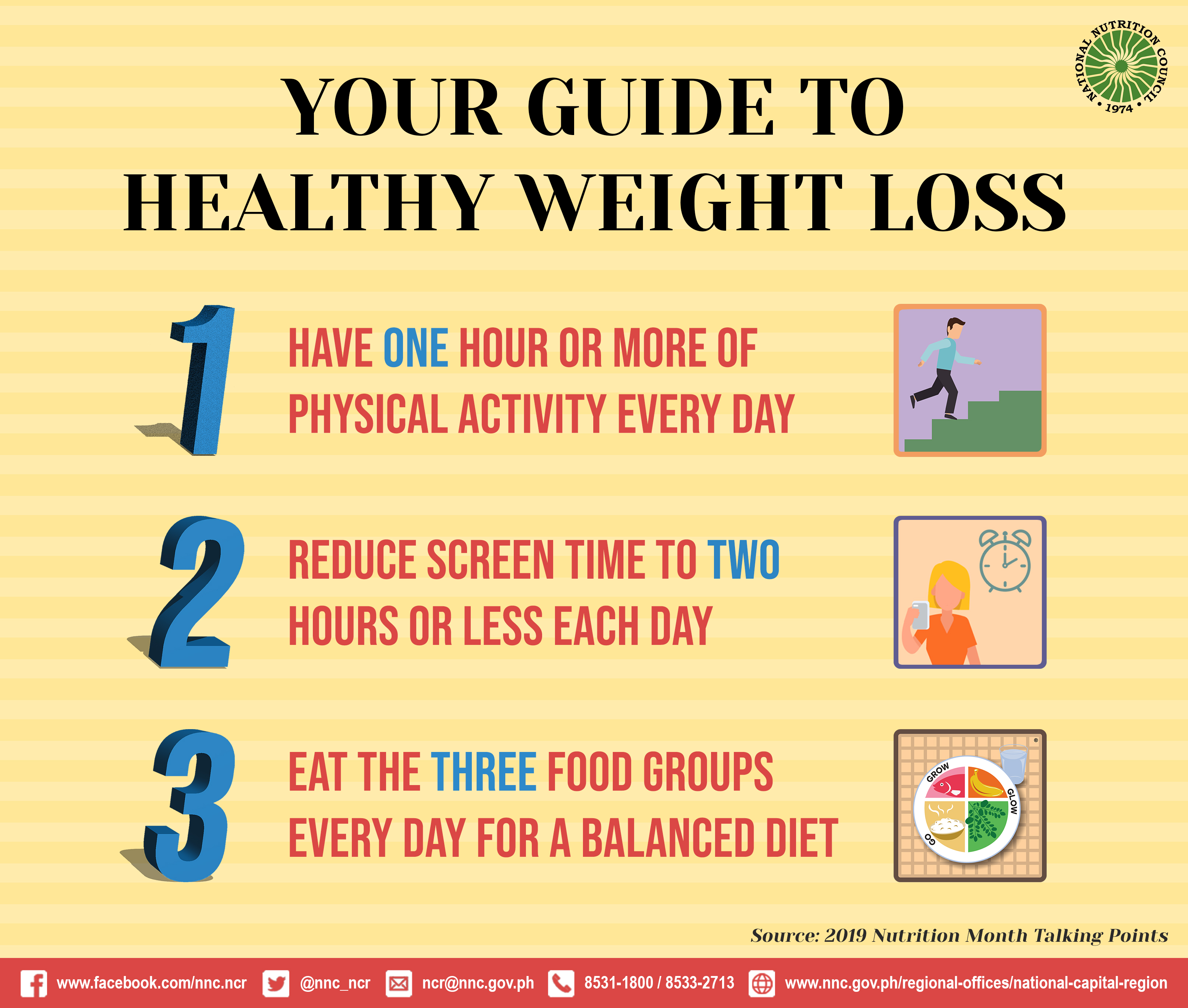
We can better remember these concepts by counting ONE, TWO, THREE:
- Have ONE hour or more of physical activity every day;
- Reduce screen time to TWO hours or less each day; and
- Eat the THREE food groups every day for a balanced diet.
For these weight loss strategies to succeed, we must change the way we view and value our health. This means that we must be critical in the choices we make; may it be from what to have for breakfast to taking the stairs instead of the elevator. Let us continue to expand our nutrition knowledge by relying on credible sources and information supported by scientific evidence.
Be nutrition champions. Let us promote good nutrition for a healthier life!
(RGRG/NPC MEVF/NNC-NCR)