


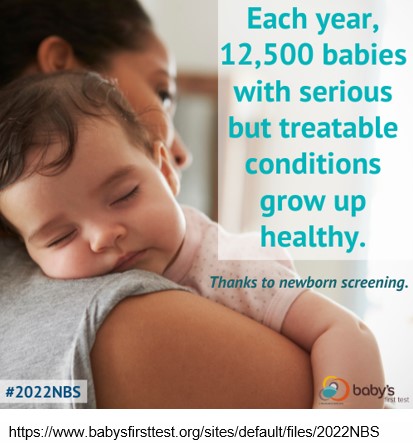
 The National Nutrition Council -Caraga joins the first week of October in celebration of the National Newborn Screening Week, as mandated by Republic Act 9288, or also known as “The Newborn Screening Act of 2004.” The celebration aims to promote early detection and management of several congenital conditions that, if left untreated, can result in mental retardation or death.
Newborn screening (NBS) is a vital public health strategy that enables the early detection and management of a number of congenital disorders. Early detection of these diseases will result in early treatment, which can improve health outcomes and aid in ensuring normal growth and development. Moreover, an early diagnosis and initiation of treatment, as well as the provision of appropriate long-term care, contribute to the affected person’s normal growth and development.
In the Philippines, NBS has been an integral component of routine newborn care since 1996. Initially, the Newborn Screening program in the Philippines only screened for six disorders: congenital hypothyroidism (CH), congenital adrenal hyperplasia (CAH), phenylketonuria (PKU), glucose-6-phosphate dehydrogenase (G6PD) deficiency, maple syrup urine disease (MSUD), and galactosemia (GAL). However, according to the Department of Health (DOH) Administrative Order No. 2014-0045, the National Comprehensive Newborn Screening System (NCNSS) has increased the screening panel from six (6) to twenty-eight (28) additional disorders.
The ENBS is accessible in hospitals, rural health units, health centers, and some private clinics. Ideally, screening occurs within the first 24 hours after a baby’s birth. A physician, nurse, medical technologist, or trained practitioner can perform the screening. A few drops of blood are extracted from the baby’s heel for testing purposes. The extracted blood is blotted on a special absorbent filter card before being sent to the Newborn Screening Center (NSC) located in selected areas of the country for processing.
One of the precious moments in life is seeing a new creature, a newborn baby. Thus, as is the case with their initial screening, taking an assessment and care are all essentials. Ensure that the infant has a healthy beginning to life by taking all the necessary precautions. Taking the initial step to inquire with the baby’s health care provider about newborn screening and to have the newborn screened shortly after birth is important. LLDOpaon/NASLabordo
Reference:
Cellucci, M. F. (2022, July). Newborn Screening Tests (for Parents). Nemours KidsHealth. https://kidshealth.org/en/parents/newborn-screening-tests.html
DOH. (2020, August 11). Newborn Screening Program | Department of Health website. Department of Health. Retrieved September 26, 2022, from https://doh.gov.ph/newborn-screening
Newborn Screening Center – NIH. (2016). Institute of Human Genetics | UP Manila. Retrieved September 26, 2022, from https://ihg.upm.edu.ph/node/15
PhilHealth. (14 December 2018). Enhancement of PhilHealth Newborn Care Package. Retrieved on 04 October 2021 from https://www.philhealth.gov.ph/circulars/2018/circ2018-0021.pdf
Patel, L. M., Reotutar, L. P., Reotutar, M. J., & Reotutar, A. J. P. (2019). Newborn Screening In The Philippines And India: Its Status And Problems Encountered In The Program. In PROCEEDING SURABAYA INTERNATIONAL HEALTH CONFERENCE 2019 (Vol. 1, No. 1, pp. 419-426).