


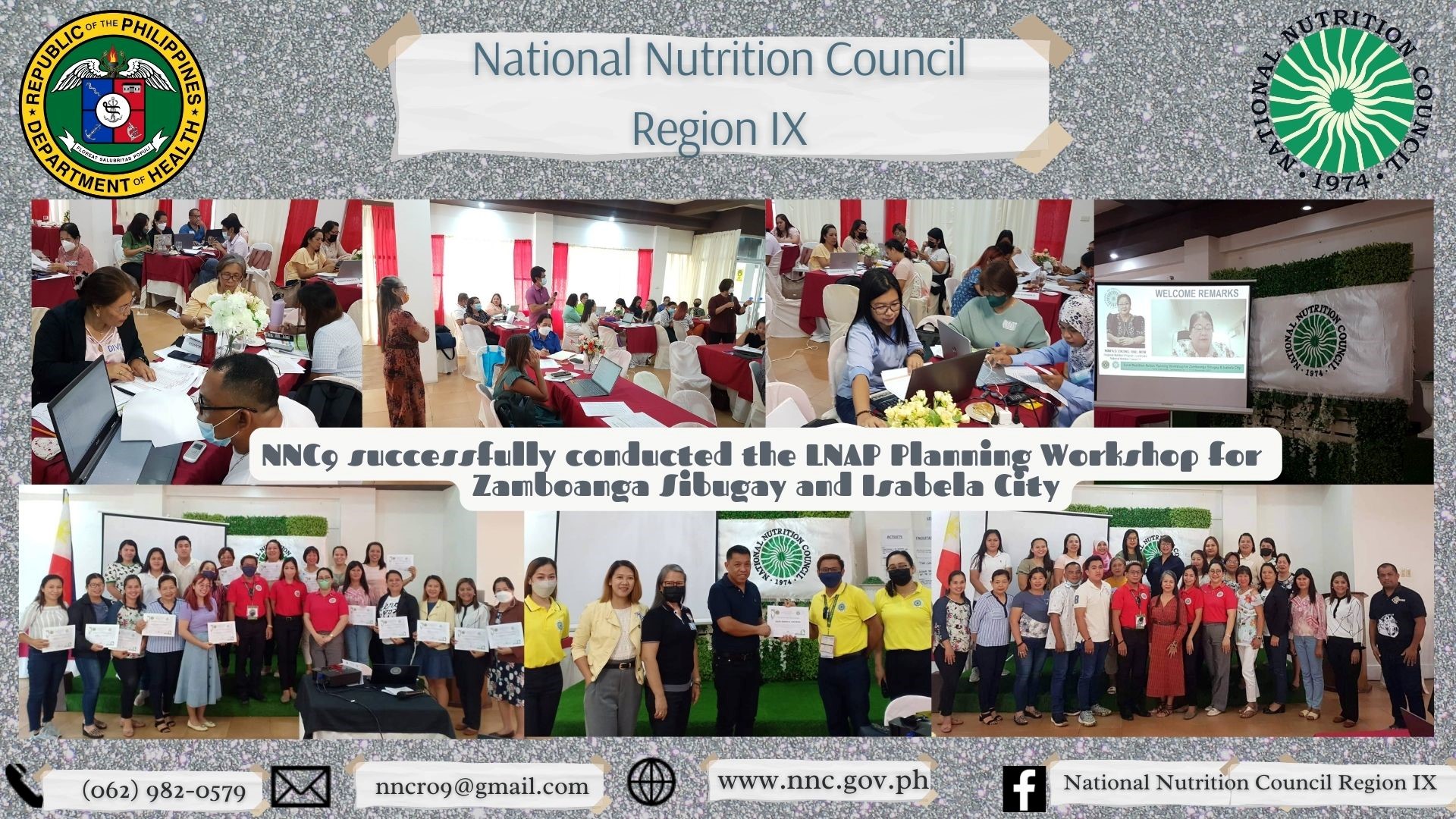
 The National Nutrition Council IX (NNC9) led by RNPC Ms. Nimfa Ekong successfully conducted the 3-day Local Nutrition Action Planning Workshop for Zamboanga Sibugay Province and Isabela City last November 21-23, 2022 at at Terra Cotta, Tumaga, Zamboanga City. The activity was attended by no less than Thirty One (31) Local Nutrition Partners from the City of Isabela and fourteen (14) LGUs from the Province of Zamboanga Sibugay and three (3) Resource Facilitators from NNC. By the end of the workshop, the participants will be able to: Explain the alarming situation of malnutrition in the country and its impact on national /local development; Articulate the need to scale up nutrition in the LGU (provincial, city, and municipal) plans and budget; Determine the absence, or inadequacy of nutrition in the priority development challenges in the PDPFP and CDP; Formulate the nutrition situation analysis, craft a nutrition-focus priority development challenge and define projects and budgets on nutrition for integration in the PDPFP, CDP, LDIP, and Prepare and take home a substantive draft of the Local Nutrition Action Plan (LNAP) 2023-2025. There are fourteen sessions in all in this three-day planning course. A common objective of the workshop is to incorporate nutrition into local development plans and budgets, building on the tenets of the NNC NPM. Contributing to the accomplishment of the nutrition outcomes intended by PPAN is the mobilization effort’s overarching objective. The intermediate goal is to increase the number of local government units (LGUs) that offer high-quality nutrition programs. To this end, we intend to produce local nutrition action plans that are incorporated into the local development investment plan and the comprehensive development plan. Mobilizing local chief executives or individuals who understand the need of funding nutrition programs and exercising leadership in nutrition action is another outcome.
Malnutrition can be eradicated nationally through the Philippine Plan of Action for Nutrition (PPAN). The Philippine Development Plan and the Philippine Plan of Action for Nutrition are linked plans. It outlines the nutrition goals, strategies, and top priorities to achieve those goals, all of which are based on the current nutrition condition. We are all aware of the complexity, significance, and implications of nutrition for current and future development. Both internationally and locally, the development agenda recognizes nutrition as a critical outcome issue. The world’s population increase and ongoing economic progress are nonetheless hampered by hunger and malnutrition. According to study findings and government statistics, malnutrition is still a major issue in the Philippines. Highlights of the nutrition condition at various periods of life also show patterns of differentiation by location, economic levels, and sex. Stunting, overweight/obesity, and wasting have showed improvements in infants and young children under the age of two but continue to be problems. Children, teenagers, pregnant women, and babies are the groups most at risk for malnutrition. Young children with low birth weight are more likely to have poor health outcomes, which have long-term effects.
On the first day and last day of the LNAP workshop Engr. Mario A. Baterna, the Provincial Director of Department of the Interior and Local Government IX of Zamboanga Sibugay Province, expressed his commitment to assist the Nutrition program. He also emphasized the necessity of cooperating in order to guarantee a good future for our kids with educated minds and hearts. The Local Nutrition Committee’s formulation of the Local Nutrition Plan and incorporation of it into other local projects is just the beginning. Malnutrition, which manifests itself in many different ways, is in fact our invisible adversary and should be eliminated through a multisectoral strategy. Now that we are aware that malnutrition, in particular stunting, has a detrimental effect on development that may have an impact on a person’s future workforce, productivity, and work performance, we must also understand that investments in nutrition have very greater reward.
DMO II-ZS Karla P. Calapardo, RND