


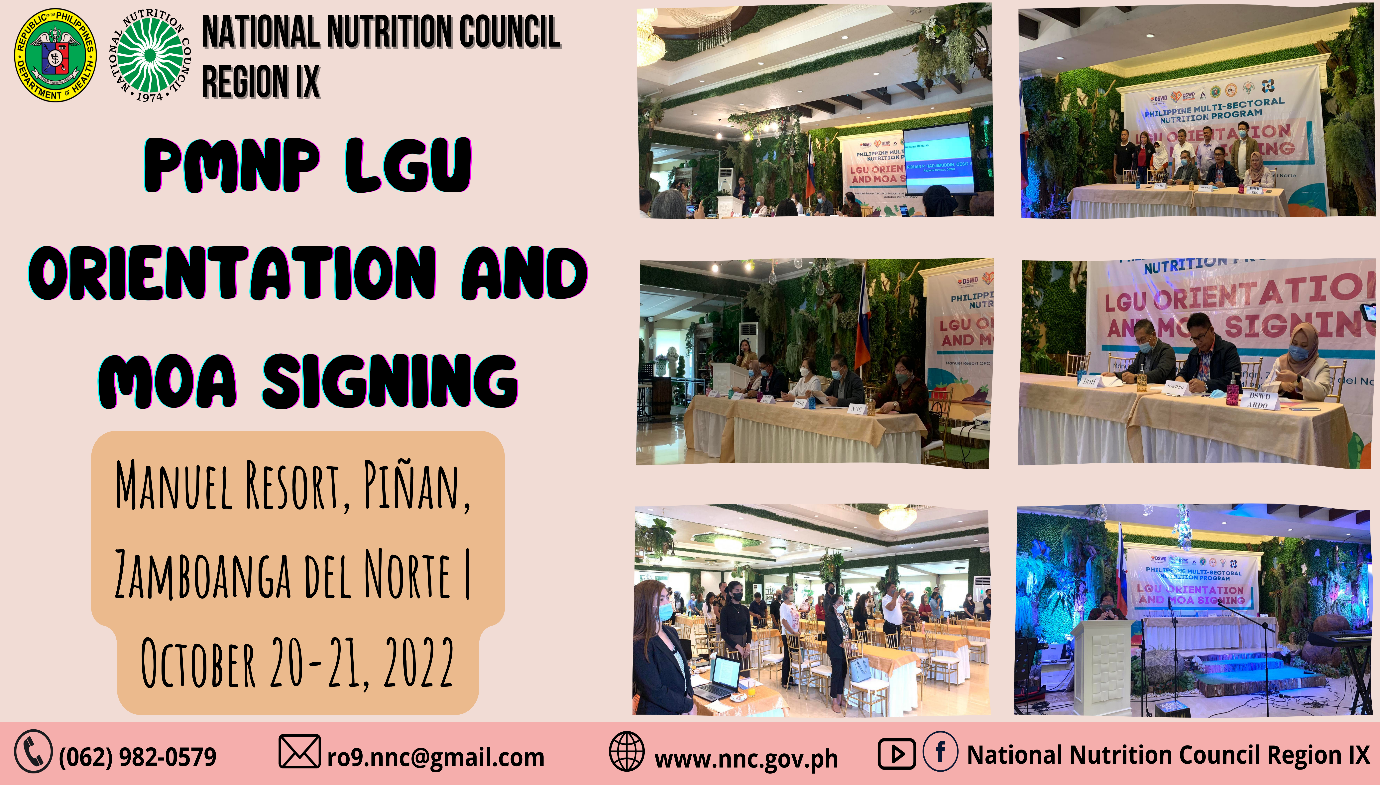
 The National Nutrition Council IX (NNC9) spearheaded by RNPC Ms. Nimfa Ekong together with DMO II (ZDS) Ms. Marie-Claire Gaas joined the Philippine Multisectoral Nutrition Program (PMNP) LGU Orientation and Ceremonial MOA Signing last October 20-21, 2022 at Manuel Resort, Piñan, Zamboanga del Norte. The activity was attended by the National Program Manager of DSWD KALAHI CIDDS, Ms. Maria Consuelo Acosta, Regional Director of DSWD 9, Mr. Riduan P. Hadjimuddin, Asst. Regional Director Officer of DSWD 9, Ms. Salmah Lao Manalocon-Basher, OIC-Regional Director of DOH-CHD 9, Dr. Joshua G. Brilliantes, Nutritionist-Dietitian IV Ms. Chrystal Jean I. Dela Cerna, Development Management Officers IV and V of PDOHO-ZDS and PDOHO-ZDN, Local Chief Executives of the pilot areas, and their representatives. In Region 9, there are nine (9) LGUs included in this program, namely, LGU Liloy, Mutia, Sergio Osmeña, and Siocon in the Province of ZDN and LGU Guipos, Midsalip, Ramon Magsaysay, Sominot and Tigbao in the Province of ZDS. The objective of this activity is to: 1. To understand the context of nutrition and well-being of the primary beneficiaries of the project the children under five years old as well as pregnant and lactating women; 2. To level-oft understanding of the project implementation guidelines and agreements; 3. To appreciate the roles, responsibilities, and accountability in the implementation of the Project; 4. To manifest deeper commitment amongst stakeholders; and 5. To advocate and champion the fight against malnutrition.
The PMNP is a project developed to support the Government of the Philippines to adopt a bold, multi-sectoral nutrition approach to deliver a coordinated package of nutrition-specific and nutrition-sensitive interventions across the various LGU platforms together with a harmonized social behavior change and communication strategy. The project hopes to achieve key impacts on the health and nutrition of children, particularly in reducing the gaps in key nutrition and maternal and child health outcomes between low-performing and high-performing regions; strengthening the institutional capacity of central agencies and LGUs to design and implement high impact nutrition interventions; and strengthening the primary health care delivery of maternal and child health services directly linked to improvements in maternal and child nutrition. The project will target LGUs based on the following criteria: i) childhood stunting, ii) incidence of poverty, and c) experience in KALAHI-CIDSS implementation, either from previous modalities of the program or with the current implementation of KALAHI-CIDSS Payapa at Masaganang Pamayanan (PAMANA) and National Community Driven Development Project (NCDDP).
The PMNP Development Objective is to increase the simultaneous utilization of a package of nutrition-specific and nutrition-sensitive interventions and improve key behaviors and practices known to reduce stunting in target LGUs. There are three (3) Project Components under the PMNP. Component 1 is Strengthened Delivery of Nutrition Interventions and Primary Health Services and the lead agency is the DOH, with NNC, DILG, DA, and MLGUs as support agencies. Component 2 is Community-Based Nutrition Service Delivery and Multisectoral Nutrition Convergence and the lead agency is the DSWD, with DILG, and M/BLGUs as support agencies. Lastly, Component 3 is Institutional Strengthening Monitoring and Evaluation with DOH and DSWD as lead agencies, and DA, DILG, and NNC as support agencies.
The Global evidence shows that efforts to deliver nutrition results require an integrated nutrition service delivery system and a robust Public Healthcare System that complements community-based nutrition initiatives. Component 1 supports the delivery of selected nutrition and healthcare services at the primary care level. Component 2 will focus on scaling up the delivery of high-impact multi-sectoral interventions targeting households. The component supports the design and implementation of household and community-level interventions to improve mother and child health and nutrition, with emphasis on the first 1,000 days of life. The interventions complement the health system interventions and SBCC interventions supported under component 1. Within this context, the component supports community-based and household-focused interventions to improve food diversity, security, and livelihoods and complement the delivery of nutrition-specific interventions. Component 3 will focus on strengthening the implementing agencies and LGUs’ capacity to execute the project. In addition, the component will support project management, evaluation, and reporting to ensure effective and efficient delivery of the project.
The expected roles of NNC Regional Offices in the PMNP are to 1. Assist covered in ensuring that their LNCs are organized and functional; 2. Lead in the preparation of the LNAP, integration in the local development plans, and annual AIPs; 3. Ensure the conduct of MELLPI in all covered LGUs as part of the management information system; 4. Provide reportorial requirements for the project, and 5. Conduct capacity-building activities for LGUs for systems strengthening as well as provide support to program training activities.
Undoubtedly, PMNP is an opportunity! The signing of the Memorandum of Agreement is only the beginning of engaging the project municipalities. The PPAN 2017-2022 is the blueprint of action for nutrition improvement and is consistent with the government’s socio-economic agenda and the All for Health towards Health for ALL of the Department of Health (DOH). Indeed, Philippine Multisectoral Nutrition Project (PMNP) will provide intervention that will focus on strengthening the delivery of essential maternal and child health and nutrition services through the primary healthcare (PHC) system as well as leverage existing community structures to take ownership of and support the delivery of community-based nutrition and nutrition-related activities. The project will support activities aimed at setting-up systems and/or scaling up the systems to enable LGUs to deliver nutrition interventions, improving service delivery and utilization as well as creating awareness of the knowledge and behaviors to improve health and nutrition.
ZDS DMO II Marie-Claire Gaas, RND