


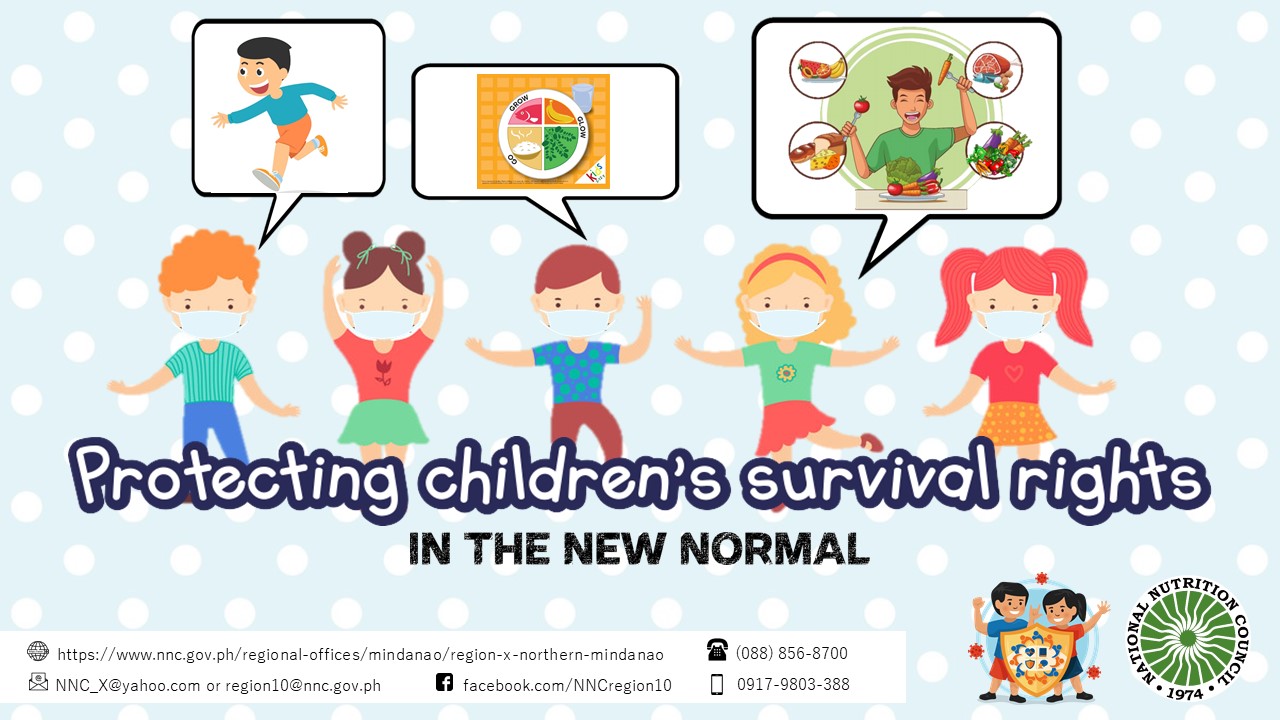
 Republic Act 10661 or “National Children’s Month Act” declares the celebration of the National Children’s Month (NCM) every November. This year commemorates the 28th year of celebrating the NCM. The theme of this year’s celebration is, “Sama-samang Itaguyod ang Karapatan ng Bawat Bata sa Panahon ng Pandemya!” calls for a holistic, collaborative care and support for children amidst the coronavirus disease (COVID-19) pandemic.
Children are entitled to four (4) core rights: survival, development, protection, and participation. Among these rights, survival rights capture a child’s right to good quality health care and nutrition services.
To ensure that children’s rights to good nutrition and health are prioritized in this pandemic, below are some tips that parents and caregivers should note:
Good quality nutrition. Childhood is characterized by a rapid growth and development. Thus, is it a given that children must be given nutritious foods to support their physical and cognitive needs and capabilities, most especially during this time of the pandemic. A Pinggang Pinoy for Kids was developed by the Department of Science and Technology (DOST) – Food and Nutrition Research Institute (FNRI) as a healthy food guide for children.
Children need carbohydrates-rich foods to fuel their daily activities and learning needs in school. These are sourced from whole grains, wheat, rice, pasta, breads, root crops and cereals. Protein, on the other hand, is especially important to support the physical growth of a child. It is needed for tissue repair and maintenance. Food sources of proteins include meats, poultry, eggs, fish, milk and legumes.
To encourage positive school performance, foods packed with essential fatty acids will help with the child’s learning capacity and behavior. Essential fatty acids are provided by sea foods including fishes, nuts and seeds and plant oils. Building stronger bones through calcium rich foods is also important, especially in the early years of life when calcium absorption is at its best. Calcium-rich foods include milk, cheese and other dairy products, dark green vegetables and legumes. Lastly, children must eat foods abundant with vitamins and minerals, namely the fruits and vegetables. These nutrients help children build resistance against infectious diseases, including COVID-19. Have the children eat their vitamins and minerals.
Young children must develop early the habit of eating meals that have variety, balance and moderation. As such, junk foods or foods with minimal nutrient contents should be avoided. Foods with too much salt, sugar or fats should not be included as well so children will not develop fondness for these kinds of food as they grow. In the current setting where children spend most of their time in their homes, they should avoid overeating or munching over junk foods.
Good health and nutrition habits. It is encouraged that parents and caregivers take on the role of helping children build good food preferences and adopt positive eating habits. Kids must learn to eat together with the family on the table instead of in front of the television or mobile phones. Children can also be involved in food preparation. Giving them responsibilities in the kitchen will give them ownership of the healthy foods that they eat. Moreover, refrain from giving them snacks when mealtime is near. As adults, do not use food to punish or reward your child.
Good support system. Adults should be good role models to the young ones—show the children that you eat healthy foods also. Instill positive perspective towards food. Be patient with your child as he/she adjusts to new foods. Parents and caregivers must also be patient in preparing fresh fruits and vegetables or other nutritious foods at home instead of feeding them with instant and processed foods. Don’t encourage your child’s negative attitude towards food. Children should be taught to be grateful for the blessings of food.
Lastly, have the children aged 6-13 years old get enough sleep at 9-11 hours and encourage physical activity at least 60 minutes daily. Limit screen time to at most one (1) hour every day. Adequate physical activity and sleep should accompany good health and nutrition for a holistic development of the child.
In the middle of the COVID-19 pandemic, the call to protect the children’s survival rights is still imperative as these actions will also help in safeguarding the well-being of children. (NO III Sheena Marie G. Talle)
References:
Department of the Interior and Local Government and United Nations Children’s Fund. (2019), Child-Friendly Local Governance Audit Handbook for the Regional and Provincial Orientations
National Nutrition Council. (2019). 45th Nutrition Month Talking Points
Healthychildren.org. (n.d.) Childhood Nutrition. Retrieved from: https://www.healthychildren.org/English/healthy-living/nutrition/Pages/Childhood-Nutrition.aspx
Mayo Clinic. (n.d.). Nutrition for kids: Guidelines for a healthy diet. Retrieved from: https://www.mayoclinic.org/healthy-lifestyle/childrens-health/in-depth/nutrition-for-kids/art-20049335
Stanford Children’s Health. (n.d.) Nutrition: School-Age. Retrieved from: https://www.stanfordchildrens.org/en/topic/default?id=school-aged-child-nutrition–90-P02280
WebMD. (n.d.) Healthy Eating Habits for Your Child. Retrieved from: https://www.webmd.com/children/kids-healthy-eating-habits#1