


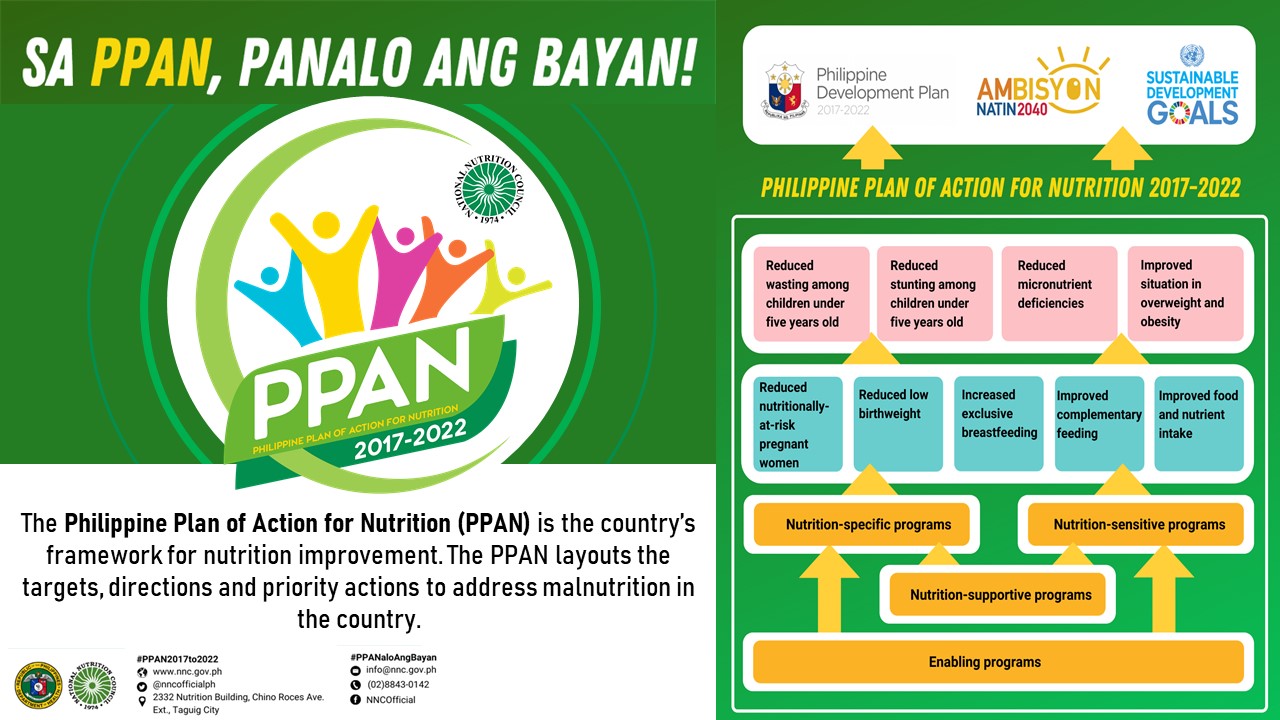
 The Philippine Plan of Action for Nutrition (PPAN) 2017-2022, the country’s masterplan in nutrition improvement, is now on its last leg of implementation and will be followed by a successor plan for 2023-2028. The National Nutrition Council (NNC) takes the lead in the formulation of the PPAN.
PPAN 2017-2022 contributes to the attainment of the targets set by the Philippine Development Plan and the Sustainable Development Goals.
Several parts make up the PPAN, which includes targets, directions, and priority actions to address wasting, stunting, micronutrient deficiencies and overweight and obesity.
Results from the National Nutrition Surveys of the Department of Science and Technology-Food and Nutrition Research Institute show favorable figures for stunting in the recent years (33.4% in 2015 to 28.8% in 2019), and fluctuating prevalence for wasting (7.1% in 2015 to 5.8% in 2019) and overweight/obesity (3.9% in 2015 to 2.9% in 2019). To add, international reports indicate that Filipinos rank second among the shortest in the ASEAN region, 9th in the global stunting burden, and 10th in the global wasting burden.
Thus, the PPAN 2017-2022 framework specifies that the interplay of the nutrition-specific, nutrition-sensitive, and enabling programs is contributory to the achievement of sub-outcome targets, and ultimately, the outcome targets.
Nutrition-specific programs are those that address immediate causes of undernutrition among mothers and children. Such programs are designed to produce nutritional outcomes. The following are the nutrition-specific programs of PPAN 2017-2022:
- Infant and Young Child Feeding
- National Dietary Supplementation Program
- Micronutrient Supplementation
- Nutrition in Emergencies
- National Nutrition Promotion Program for Behavior Change
- Mandatory Food Fortification
- Integrated Management of Acute Malnutrition
- Overweight and Obesity Management and Prevention Program
On the other hand, nutrition-sensitive programs aim to address the underlying causes of malnutrition. These include programs and projects that are not directly designed to produce nutritional outcomes, but are developed and modified to do so. Tweaking of programs can include targeting of households with undernourished children, or those with pregnant women and children below two years old.
To support the implementation of the nutrition-specific and nutrition sensitive programs, the enabling programs come into play. This comprises of the mobilization of local government units to prioritize and invest in nutrition, policy development for food and nutrition, and strengthened management support through enhanced resources, including manpower.
For the PPAN to work, strategic thrusts are aligned to achieve the planned goals. These are: 1) focus on the First 1000 Days of life, 2) Complementation of nutrition-specific and -sensitive programs, 3) reaching the geographically isolated and disadvantaged areas, indigenous peoples, and urban poor, and 4) complementation of actions of national and local government.
The PPAN 2017-2022 expresses that malnutrition is a crisis that needs urgent and scaled-up interventions.
With the current PPAN nearing its end of term, all actions for nutrition improvement shall be sustained to ensure continuity of services to the nutritionally vulnerable groups. Indeed, sa PPAN, panalo ang bayan! (NO III Sheena Marie G. Talle)