


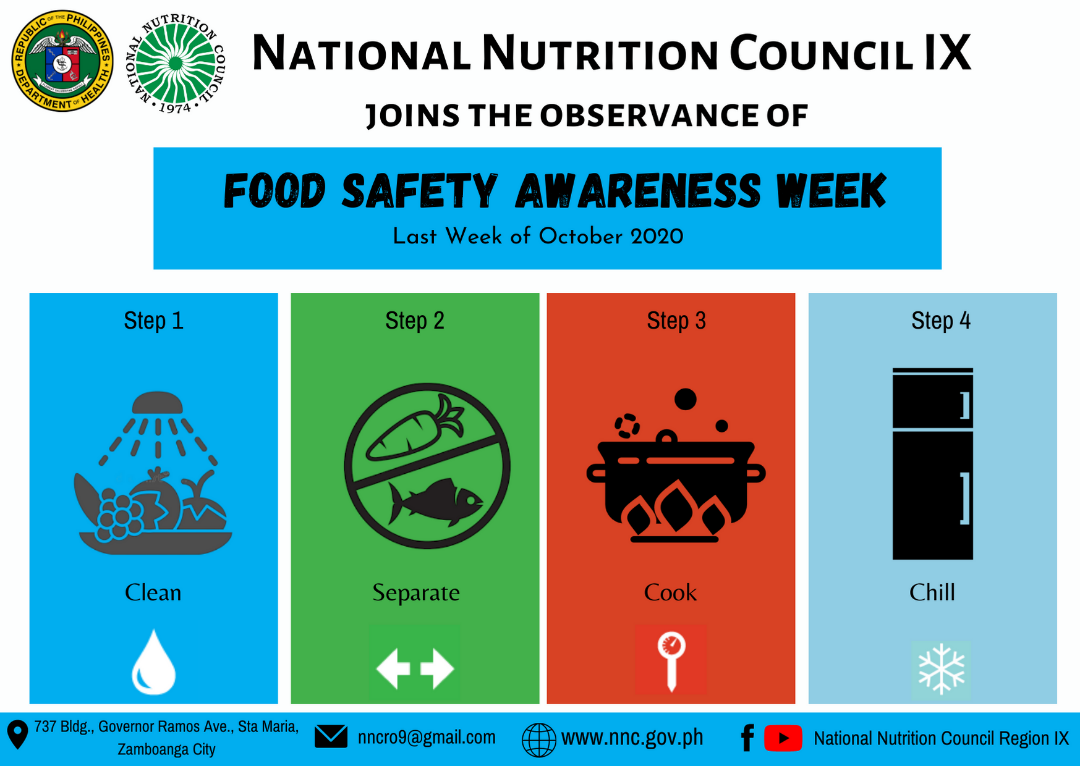
 By virtue of Proclamation No. 160 series of 1999, last week of October every year is observed as Food Safety Awareness Week to create public awareness and to educate people in food safety in order to reduce and ultimately eradicate food poisoning and other foodborne illness that may have resulted to death in the Philippines.
Foodborne illnesses or diseases are infections caused by a variety of bacteria, viruses and parasites that are contaminated on consumed foods or beverages. In the Philippines, there were 209 reported foodborne disease outbreaks (FBDOs) for the year 2005-2018 based from the study conducted by Department of Food Science and Nutrition of the University of the Philippines. Common symptoms that can be observed on an infected person on these illnesses are nausea, vomiting, stomach cramps and diarrhea. These symptoms may differ from being severe to being life threatening depending on which type of foodborne illnesses a person was infected.
A food that is mishandled at any stage of food production, delivery and consumption process is the major cause for foodborne illnesses. They can result from several forms of environmental contamination including pollution in water, soil or air, as well as unsafe food storage and processing. However, these contaminations can be prevented with proper safe food handling behaviors which can be done with four easy steps: Clean, Separate, Cook and Chill. Below are the easy to follow guides for each step:
1. Clean: Wash your hands and surfaces often – Germs that cause food poisoning can survive in many places and spread around your kitchen.
- Wash hands for 20 seconds with soap and water before, during, and after preparing food and before eating.
- Wash your utensils, cutting boards, and countertops with hot, soapy water.
- Rinse fresh fruits and vegetables under running water.
2. Separate: Don’t cross- contaminate – Raw meat, poultry, seafood, and eggs can spread germs to ready-to-eat foods—unless you keep them separate.
- Use separate cutting boards and plates for raw meat, poultry, and seafood.
- When buying grocery items, keep raw meat, poultry, seafood, and their juices away from other foods.
- Keep raw meat, poultry, seafood, and eggs separate from all other foods in the fridge.
3. Cook: To the right temperature- Food is safely cooked when the internal temperature gets high enough to kill germs that can make you sick.
- Use a food thermometer to ensure foods are cooked to a safe internal temperature. Keep in mind that you can’t tell if food is safely cooked by only checking its color and texture. Here are the right temperatures for certain foods to ensure that they are safely cooked:
– Whole cuts of beef, pork, veal, and lamb – 145°F (then allow the meat to rest for 3
minutes before carving or eating)
– Ground meats, such as beef and pork – 160°F
– Poultry, including ground chicken and turkey – 165°F
– Leftovers and casseroles – 165°F
– Fin fish – 145°F or cook until flesh is opaque
4. Chill: Refrigerate promptly – Bacteria can multiply rapidly if left at room temperature or in the “Danger Zone” which is between 40°F and 140°F. Make sure to never leave perishable food out for more than 2 hours or 1 hour if room temperature is higher that 90°F.
- Keep your refrigerator at 40°F or below and know when to throw food out.
- Refrigerate perishable food within 2 hours. If outdoor temperature is above 90°F, refrigerate within 1 hour.
- Thaw frozen food safely in the refrigerator, in cold water, or in the microwave. Never thaw foods on the counter, because bacteria multiply quickly in the parts of the food that reach room temperature.
Just as healthful eating is a priority, understanding food safety is also an important component to staying healthy. Since Filipino people are known for being thrifty or economical even with food, they tend to always look for ways not to waste any resources. But with food, always remember the slogan “When you are in doubt, throw it out” as food safety is one of the important investments for you and your family’s safety. After all, hospital services are more costly than safe food handling practices.
References:
1. Official Gazette from https://www.officialgazette.gov.ph/1999/08/16/proclamation-no-160-s-1999/
2. World Health Organization “Food borne diseases from” https://www.who.int/health-topics/foodborne-diseases#tab=tab_1
3. Center for Disease Control and Prevention “Foodborne Germs and Illnesses” https://www.cdc.gov/foodsafety/foodborne-germs.html
4. Center for Disease Control and Prevention “Four Steps to food safety” from https://www.cdc.gov/foodsafety/keep-food-safe.html