


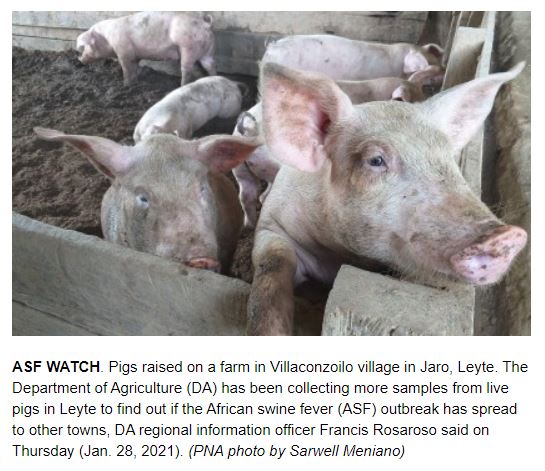
 TACLOBAN CITY – (Sarwell Meniano) The Department of Agriculture (DA) has been collecting more samples from live pigs in Leyte to find out if the African swine fever (ASF) outbreak has spread to other towns.
This week, over a hundred samples randomly collected from live swine in the towns of Dulag, Burauen, Mayorga, Pastrana, and Barugo have been sent to the Bureau of Animal Industry (BAI) Animal Disease Diagnosis and Reference Laboratory for confirmatory testing, DA Eastern Visayas regional information officer Francis Rosaroso said in a phone interview on Thursday.
Samples sent to BAI main office in Manila are from pigs who tested positive for ASF through rapid testing. These areas are close to Abuyog, Javier, and MacArthur, the towns with ASF cases confirmed by BAI earlier.
“Our appeal to local government units is to seriously address the spread of the animal disease in their areas. They have to create or activate their ASF task forces and step up efforts to regulate the movement of live pigs and pork meat,” Rosaroso said.
Initial investigation showed that the ASF virus could have been transmitted to local farms in Leyte through infected boar being used for natural mating and by hog traders who may have fed their stocks with contaminated food products.
On Jan. 14, the DA confirmed the first case of ASF in the Visayas region in Abuyog town in Leyte, forcing authorities to cull thousands of hogs within a 500-meter radius.
The agriculture department announced on Jan. 19 that confirmatory tests showed that blood samples taken from five villages from the nearby towns of Javier and La Paz in Leyte, were positive for the ASF virus.
As of Jan. 27, at least 1,600 pigs have been culled to contain the spread of the disease.
As of the end of 2020, the entire province has 127,725 live pigs.
Pigs affected by ASF usually manifest high fever, distinct reddish areas on the skin of the neck, chest, and extremities, and bleeding of internal organs that could lead to death within two to 10 days. (PNA)