


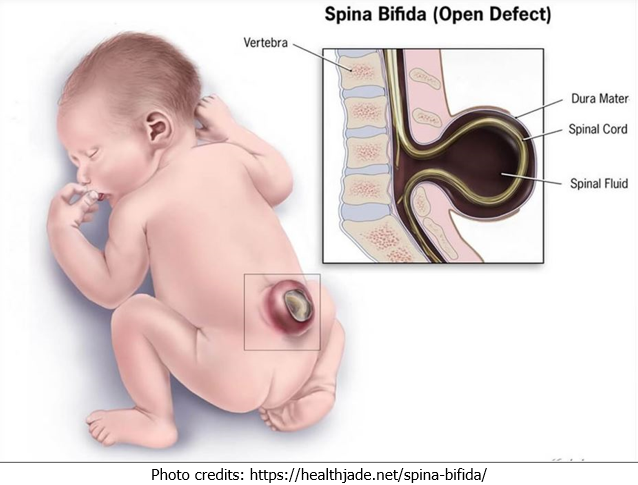
Spina Bifida is a birth defect that can be treated and prevented. As we celebrate Spina Bifida Month in October and World Spina Bifida Day on October 25, we place emphasis on the crucial role of the national and local government as well as families in continuing to provide interventions to address the nutrition of pregnant women and young people of reproductive age in the time of COVID-19 pandemic.
Spina Bifida is a type of neural tube defect (NTD) that occurs when a baby’s neural tube fails to develop or close properly – the literal meaning for Spina Bifida is “split spine.” Typically occurring within the first 28 days of pregnancy while the neural tube is forming, it often occurs even before a woman knows she is pregnant. This is commonly referred to as the “snowflake condition” of birth defects because no two cases are the same and Spina Bifida can range from mild to severe. The severity depends on everything from the size of the opening to the location on the spine.
Today, we have been focusing our efforts on addressing the issue of teenage pregnancy that we seem to forget the aspect of improving the pre-conception health of adolescent girls and boys of reproductive age especially on the matter of Folic Acid Supplementation. It is a common misconception that Folic Acid or Folate must only be taken when a woman is already pregnant and it is only for the consumption of women. I beg to disagree. Folate or Vitamin B9 is an important vitamin to develop a healthy body since it plays a vital role in the generation of healthy cells in our body such as Red Blood Cells. It is recommended that adolescent boys and girls age 14 years old and above to take 400 micrograms of Folic Acid every day. Adequate Vitamin B9 supplementation of women of reproductive age has been known to reduce 70% of the chances of giving birth to babies with Neural Tube Defects and facial clefts.
That is why I welcome the initiative of the Department of Health and the Department of Education in implementing a school-based Weekly Iron-Folic Acid (WIFA) Supplementation Program among female grades 7 to 10 students throughout the country. The WIFA program is a component of the Menstrual Health Management Project of DepEd and the DOH Micronutrient Support, and Adolescent Health Development Programs since it was identified that iron and folic acid supplementation was acknowledged as one of the interventions to address iron deficiency anemia and folate deficiency among women of the reproductive age, including adolescents. WIFA supplementation is expected to contribute to the reduction of the participants’ absenteeism due to ill health and the eventual improvement of their school performance.
As we face the COVID-19 pandemic, it is important that programs that reinforce the nutrition of adolescents and youth will be continued even if they are not in schools such as WIFA. Barangay Healthcare Workers and Nutrition Scholars can be tasked to distribute Folic Acid to students at home while observing COVID-19 health protocols. Our gains must not be lost just because we had a pandemic.
COVID-19 is an opportunity that we encourage families especially the youth to start doing backyard gardening and planting food that is rich in Folic Acid since one can get folic acid through the food you eat. Folate is found naturally in some food, including spinach, nuts, and beans. Folic acid is also found in fortified food (called “enriched food“), such as bread, pasta, and cereal.
Let us help raise awareness on neural tube birth defects and rare disorders in the country, for adolescent girls to participate in the WIFA Supplementation Program of DepEd and DOH, advocate for the expansion of coverage of Newborn Screening (NBS) in your locality, support the implementation of PPAN 2017-2022 and find time to commit yourself to cultivate a healthy and nutritious food for your family, thus, ensuring not only good nutrition but also food security. #LeoChristianLauzon